Legal workflow automation to improve operational efficiency is about using technology to streamline how legal tasks are initiated, managed, and completed. Instead of relying on manual processes like email chains, spreadsheets, or back-and-forth messaging, automation enables legal teams to handle work more consistently and with less effort.
In this blog, we will discuss how automating legal workflows can reduce delays, eliminate repetitive tasks, and improve visibility, ultimately helping legal teams operate more efficiently.
Why Operational Efficiency Matters in Legal Teams
Operational efficiency is a popular ambition in legal, yet rarely defined in useful terms. Most teams will claim they want to “work smarter,” but what that means day-to-day is often unclear. In practice, it’s the difference between answering intake requests from a shared inbox versus having a structured, automated system that eliminates the back-and-forth communications.
The problem is that too much effort goes into low-value, repetitive tasks such as reviewing NDAs that could be self-served, chasing stakeholders for missing information, or updating spreadsheets the broader business won’t understand.
These inefficiencies compound over time and end up draining resources, obscuring visibility, and creating the illusion of busyness without progress. And while they’re easy to ignore in a steady state, they become impossible to manage when request volumes spike or business demands increase.
That’s why operational efficiency matters. It’s about removing unnecessary friction so legal can focus on the work that actually requires legal judgment.
Identifying Inefficient Legal Processes
Most inefficiencies in legal hide in plain sight. A contract request that sits in someone’s inbox for three days before being actioned doesn’t set off alarms, nor does a handover call where two lawyers realize they’ve both been working on the same matter, unaware of each other’s involvement.
Instead, inefficiency shows up subtly in duplicate work, status updates that go out of date the moment they’re sent, or approvals that stall because someone was left off an email thread. And these patterns are symptoms of a system built on manual coordination and individual effort, rather than structured workflows. Legal work becomes scattered across channels like email, direct messages, spreadsheets, and ticketing tools.
The first step to operational efficiency is seeing this clearly. Not every process needs to be rebuilt, but every recurring pain point—whether it’s triage, tracking, or turnaround—deserves scrutiny.
Automating High-Volume and Repetitive Tasks
Not all legal work is strategic. A surprising amount isn’t. For example, NDAs, conflict checks, marketing reviews, and policy acknowledgements are all necessary legal matters, but not exactly the best use of a senior lawyer’s time.
However, without automation, these tasks flow to legal anyway. Why? Because they’re easy to ask for and hard to manage manually at scale. And as volume increases, so does the drag on the team.
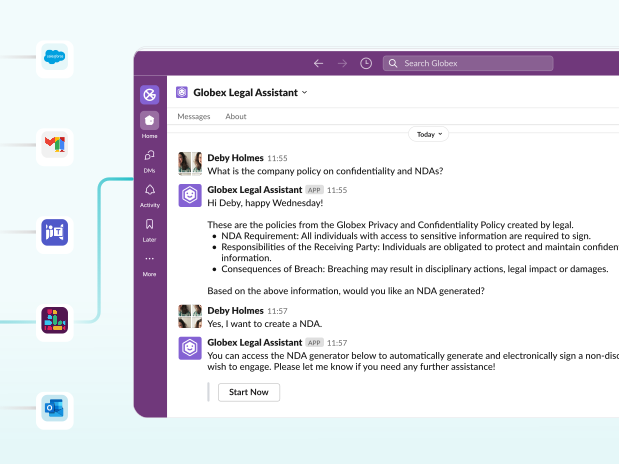
This is where legal workflow automation to improve operational efficiency earns its keep. Automating these high-frequency, low-complexity requests removes the need for legal to get involved every time. Instead of reviewing a near-identical NDA for the fifth time this week, legal can set the rules once, then let the workflow handle the rest: intake, generation, conditional approvals, e-signature, and logging.
The same applies to other repeatable tasks. Conflict of interest disclosures? Automate the low-risk approvals. Contract review triage? Let the automated workflow decide if legal review is even needed. This helps to reserve legal for the work that actually requires it.

Integrating Workflows Across Business Functions
Automating legal workflows to improve operational efficiency is about the broader business. The most effective workflows are integrated ones. For instance, legal processes that connect directly with finance, HR, procurement, and product through structured, cross-functional automations.
Approvals route to the right people and data flows cleanly into source systems. That way, the business doesn’t need to chase legal for updates, because status lives in a dashboard. Additionally, legal doesn’t need to chase the business for information, because intake is standardized at the start.
Efficiency, at this level, saves both time and helps to remove the invisible friction that slows the business down.
Benefits of Improved Efficiency Through Automation
The value of legal workflow automation to improve operational efficiency shows up in metrics, in morale, and in how often legal is called a bottleneck (or not).
Turnaround times shrink and NDAs go from five-day slogs to one-hour tasks (with no lawyer ever touching them). Intake stops being a black hole, and work is triaged automatically, routed correctly, and tracked without someone managing a spreadsheet on the side.
But beyond speed, automation also brings consistency. Every request follows the same process so legal doesn’t need to worry about steps missed, approvals skipped, or version confusion. That consistency is what builds trust with the business and what gives legal the data to show where time is spent and where value is delivered.
There’s also the very real benefit of focus. Free from repetitive admin, lawyers can concentrate on higher-value work such as strategic advice, complex negotiations, and critical risk decisions.
Lastly, there’s visibility. Legal dashboards connected to legal workflow automation software replace shared inboxes. Leadership can easily see what legal is working on and what’s slowing things down. That kind of transparency improves operations and changes how legal is perceived.
Key Takeaways
Legal workflow automation to improve operational efficiency is not about chasing innovation for its own sake. It’s about removing avoidable friction from legal work.
Most inefficiencies like manual intake, unstructured approvals, and repetitive tasks, aren’t problems of effort, but of process. And legal automation solves that.
When done right, workflow automation for legal delivers faster turnaround, fewer errors, better data, and more time for lawyers to focus where it matters. And importantly, it scales. As the business grows, legal doesn’t need to grow linearly with it.
Want to see what that looks like in practice? Book a demo today and discover how legal workflow automation can improve operational efficiency in your team.