

When sales velocity slows, the conversation almost always stays inside the sales organization. Factors like pipeline quality, ramp time, win rates, and deal slippage become the main topics of examination. But sales velocity is a downstream signal of how the entire revenue-supporting machinery is performing, and several functions live inside that machinery. Legal is one of them, and it’s often the one most overlooked when the metric slips.
A slowing rate of sales doesn’t necessarily mean legal is the bottleneck. But almost every deal does involve legal sign-off at some point, which means legal sits directly on the critical path to revenue. When requests pile up at intake or stall during triage, that slowdown shows up in sales numbers before it shows up anywhere else.
Sales velocity is a richer signal than most companies treat it as, and some of what it flags may be happening within the legal function. So, let’s explore how to read the metric more carefully and what legal leaders should be doing with what it surfaces.
What Is Sales Velocity and How Does Legal Affect It?
Sales velocity is a composite metric made up of the number of opportunities, multiplied by average deal size and win rate, divided by sales cycle length.
The first three components (number of opportunities, average deal size, and win rate) are sales-team levers. The fourth one (sales cycle length) is where multiple functions, including legal, live.
Cycle length contains everything that happens between the first qualified opportunity and the signed contract. Sales-side activity sits inside it: prospecting, qualification, demos, proposal cycles, negotiation rounds. But so does everything else such as legal review, redlines, risk approvals, DPA conversations, MSA modifications, and procurement back-and-forth on the buyer side, mirrored by legal back-and-forth on the seller side. On enterprise deals, the contract cycle alone can take 60 to 90 days, according to benchmarking research from World Commerce & Contracting, and procurement and legal review can add 30 to 60 days to the broader sales cycle.
Almost every meaningful deal needs legal to sign off on something (i.e. standard MSA terms, custom redlines, privacy commitments, indemnification limits, etc.). Each of those touchpoints are a moment where the deal pauses and waits on legal.
When the wait is short and predictable, the cycle keeps moving. When it isn’t, the cycle stretches, and the math of sales velocity gets worse.
Why Legal Is Often Left Out of Sales Velocity Conversations
There are good reasons sales velocity discussions stop short of legal. Sales has the most visible time-based metrics in the business. Sales cycle length is tracked weekly, sales leadership escalates fast when those numbers move in the wrong direction, and the CRO sits in front of the CEO and CFO with revenue data on a regular cadence. Oftentimes, legal doesn’t have the same reporting rhythm.
There are also cultural reasons. Sales leaders are reluctant to point at legal directly because the working relationship matters. Legal leaders are reluctant to volunteer themselves into a revenue conversation that might land on them as a problem rather than a partner. Both sides have an incentive to keep the discussion on familiar ground.
This creates a blind spot. Several functions contribute to sales cycle length, but only one of them, sales itself, gets examined in detail when the metric slips. Marketing operations, finance approval workflows, procurement responsiveness, and legal review all play a role. Legal is usually the one that gets the least attention, even though it’s also one of the most consistent dependencies in the cycle.
How Legal Becomes a Bottleneck in the Sales Cycle
When legal contributes to a slowdown, the bottleneck almost always sits at the front of the function rather than in the legal work itself. The actual review of a contract, when a lawyer has it in front of them and knows what’s being asked, is rarely what creates the delay. The delay comes from what happens before that point. Three patterns are worth watching:
Requests Get Stuck at the Intake Stage
A sales rep sends a redline request through email, Slack, or a general e-form. The request sits unread for a day or two while it competes for attention with everything else in someone’s inbox. Or it lands without the appropriate context legal needs to act on it, and the back-and-forth communication begins. Either way, the deal velocity starts to slow down before any lawyer has even looked at it.
Triage Is Inconsistent
Two similar requests come in on the same day. One gets routed to the right lawyer immediately. The other sits in a queue because nobody has decided where it belongs. Without consistent triage logic, urgency becomes a function of who is loudest, not what matters most to the business. Some deals move fast. Others slip.
The Legal Function Can’t See What’s Coming In
Requests arrive through too many channels, in too many shapes, and with too little structure. Lawyers respond to what’s in front of them, but nobody has a view of the full incoming pipeline. Work that should be prioritized doesn’t get prioritized, because no one can see it clearly enough to make the call.
In each of these patterns, the way work enters and moves through the function is the problem. And because intake and triage sit upstream of every contract review, every approval, every sign-off, even small inefficiencies at that stage compound into meaningful delays downstream.
How to Diagnose a Slowing Sales Cycle Across Functions
If sales velocity is a cross-functional signal, the response to a slowing number should be cross-functional too. Here are three concrete moves worth making:
1. Examine Cycle Length Contribution of Every Function
Sales-side levers are usually well understood by the time velocity becomes a board-level discussion. The legal-adjacent contribution, the procurement contribution, and the finance approval contribution are less so. Pulling cycle time data for each of these layers is the first step in understanding what’s actually moving the metric, and which lever has the most room to move.
2. Bring Legal into The Revenue Conversation
Most GCs are involved in deal escalations. Far fewer are involved in the broader conversation about how deals move through the company. A GC who shows up to that conversation with a clear view of how requests are entering and moving through legal is a more credible partner than one who shows up reactively when something has already gone wrong.
3. Focus on the Front Door to the Legal Function
If legal is contributing to the slowdown, the fix is almost always at the intake and triage stage. Adding lawyers without addressing how work reaches them rarely moves the metric. Making sure requests enter the function in a structured, prioritized, routable way almost always does.
How to Stop Legal From Slowing Down Sales
If legal is going to make sure it’s not the bottleneck on the next deal, the fix isn’t more legal capacity. It’s a stronger front door. That means a consistent, structured way for requests to enter the legal function, a reliable triage process that decides priority and routing before a lawyer ever opens an email, and a clear path from intake to the right person, system, or self-service process, depending on the request.
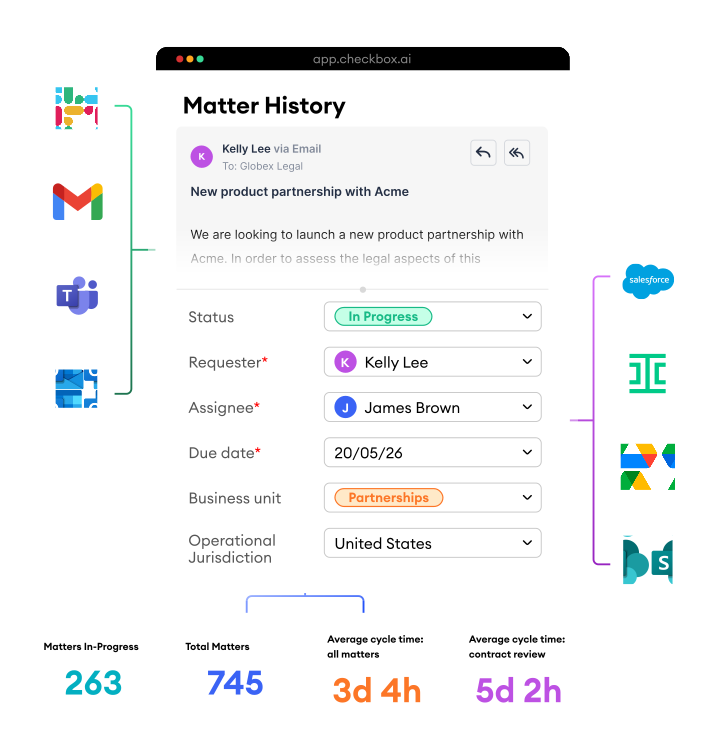
When that layer works, the rest of the function moves faster as a consequence. Contracts that need review get to the right lawyer quickly, standard requests get answered without consuming senior legal time, sales reps stop chasing legal for status updates because the system is already moving the work forward, and the part of sales cycle length that lives inside legal stops being unpredictable.
Key Takeaways
Sales velocity is a downstream signal of how the entire revenue-supporting machinery is performing, and the parts it’s flagging extend well beyond sales. Legal is one of those parts, and the most common place it shows up is at the intake and triage stage, where deals quietly stall before any lawyer has even started the work.
The legal leaders who pay attention to this signal, and to what’s happening at the legal front door of their own function, are better positioned to keep deals moving and to be partners in the revenue conversation, rather than arriving in it after the fact.
If your company is asking why sales velocity has slowed and you suspect requests are stalling before they reach the right lawyer, book a call with one of our technology consultants to see what a stronger AI-powered Legal Front Door looks like.