Every legal team has lived through some version of this. Someone asks for the latest advice on a matter, or a signed agreement from three years ago, or the approval that sat behind a decision nobody can quite reconstruct. You know the document exists, but you just can’t say where. Ten minutes later you’re still digging through Outlook, SharePoint, Teams, a network drive and someone’s desktop, and you end up messaging a colleague: “Do you remember where we saved this?”
It’s more than an annoyance; It’s a symptom of a bigger problem. As lawyers, we spend most of our time creating knowledge (advice, contracts, negotiations, approvals, research, correspondence) and comparatively little thinking about what happens to it once the matter closes. Good filing isn’t an administrative afterthought. Done well, it’s part of practicing law properly. And, for an in-house team who regularly touch matters months if not years apart (think contract renewals as an example), it’s part of making sure whoever touches the matter next has all the relevant information to make an informed decision on how to handle the matter at hand.
Filing is About Much More Than Storing Documents
Some lawyers treat filing as the last administrative box to tick before a matter closes. I’d put it near the top of the list instead. Get it wrong and the effects ripple across the whole legal function. For example, it can lead to lawyers slowing down and reinventing advice instead of reusing it. Flowing from this, reporting turns into a manual slog, new team members can take longer to get up to speed, and increasingly AI has far less to work with. If every answer starts with “I know I’ve seen that somewhere”, you’ve already lost the time that mattered.
The goal was never just to save documents. It’s to make them easy to find, easy to understand and easy to leverage.
Think About Information, Not Folders
Most legal teams still organize their work in folders. That made sense a couple of years ago when browsing directories was the main way you found anything. It’s not really how people work now, as people search, and increasingly, systems search on their behalf. That’s where metadata comes into its own.
-
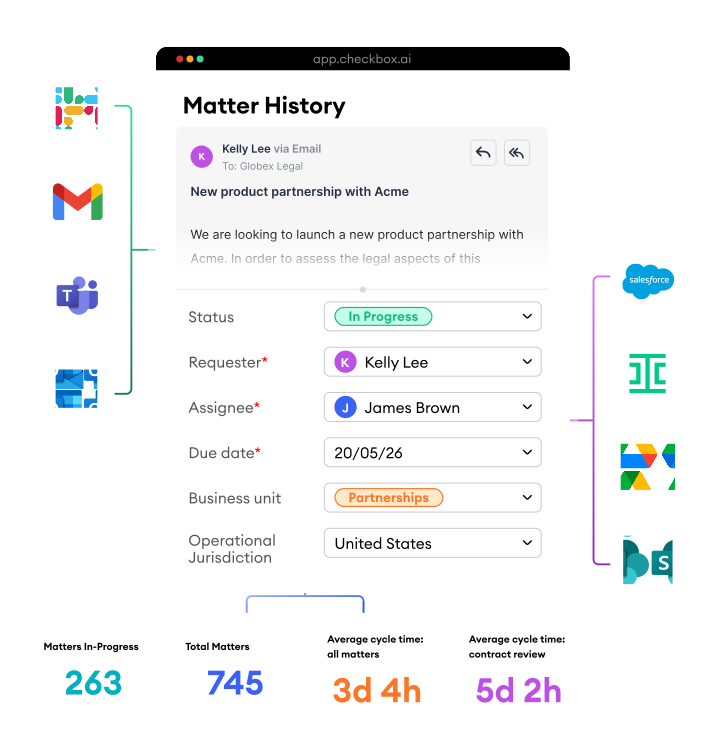
Instead of just dropping a contract into a folder, imagine every matter also capturing the information around it, for example, the matter owner, business unit and practice area; the counterparty, matter type and jurisdiction; a risk rating, status and key dates; and links to related documents and matters.
-
Now you’re not hunting for a document, you’re querying information, which is a genuinely different experience. Rather than asking a colleague where a file lives, you can put questions to the system directly: show me every procurement matter over $500,000, find all the privacy matters involving a particular business unit, list every contract currently awaiting signature, or pull up every matter tied to a given supplier.
Those become simple searches rather than detective work.
Every Matter Should Tell Its Own Story
In the age of AI and semantic search, someone should be able to pick up a legal matter cold, without tracking down the lawyer who ran it, and understand exactly what happened. The request, the documents, the approvals, the advice, the negotiations, the key decisions, the outcome – it should all be sitting there. If the lawyer who handled the matter resigned tomorrow, another lawyer should be able to open the file and pick up exactly where it left off.
That’s not only good knowledge management, but also just good legal practice.
Consistency Beats Complexity
You don’t need a sophisticated filing framework, but something that people will actually stick too. A good filing and matter management system is intuitive, easy to remember, and easy to implement. The job of a lawyer is mentally taxing enough without making admin tasks an exercise in mental gymnastics. The net result is a system that lawyers actually stick to, and in my experience, the best matter management systems take decisions away from lawyers rather than handing them more.
These systems should already know where something belongs instead of asking, and most of the metadata should be captured automatically rather than typed by hand. The less friction there is, the more lawyers are likely to use it consistently. In the end, this is the yardstick by which the baseline of success is measured.
AI Has Made Good Filing Even More Important
If the last couple of years have made one thing obvious, it’s that AI is only as good as the information it can actually reach. At first prompt engineering was the focal point, but as AI literacy increases, so does the focus on context engineering as a key means of securing the best possible AI outputs.
Legal knowledge within many in-house functions is often scattered across email folders, Teams chats, SharePoint sites and personal drives, which does not set AI up for success when running meaningful queries that are intended at solving real pain points. For example, a direct AI query about “the last 5 deals involving company X” or “how many of our contracts limit liability to 3 x fees” in a cohesive matter management system is likely to return a far superior (and likely more correct) response than one where the data layer is inconsistent, disparate and/or lacking.
When every matter is consistently organized in one place with structured metadata, documents, approvals and communications all linked together, AI starts earning its keep. It can more easily retrieve past advice, surface similar matters, summarize history, spot trends and recommend next steps. In essence, cleaning and organizing the context layer turns AI from an engine into an assistant, and your lawyer from detective (who fill in the blanks) to consumer (who surface insights and makes data driven decisions accordingly).
None of that works if your filing system still depends on someone remembering where they put a document three years ago and the correspondence linking to that document is sitting (untagged) in different unconnected systems.
A More Efficient Model for Managing Matters
This is the exact problem modern matter management software like Checkbox are built to solve. Instead of treating filing as something lawyers clean up at the end, organization gets built into the matter from the moment it’s opened. Requests land in one place, documents, tasks and approvals stay tied to the matter they belong to, and metadata is captured automatically rather than added as an afterthought. Work can be routed, progress tracked in real time, and reporting pulled without anyone maintaining a spreadsheet on the side. Most importantly, the AI Agent can surface key insights as matters accrue over time, letting the legal team get on with the work they’ve been employed to do rather than spend hours on admin.
Final Thoughts
Lawyers spend years building institutional knowledge. The hard part was never creating it, but making sure the next person can find it, trust it and build on it. Everything in this piece (consistent filing, structured metadata, matters that tell their own story, AI that actually helps) comes back to that one idea. Get the foundations right and the rest follows. This means less time searching, better decisions, and a legal function that compounds what it already knows rather than rediscovering it each time. Get them wrong and you’re back to messaging a colleague, hoping they remember where something lives. Because if you can’t find it, it may as well not exist.