

Where Does Legal Work Really Begin?
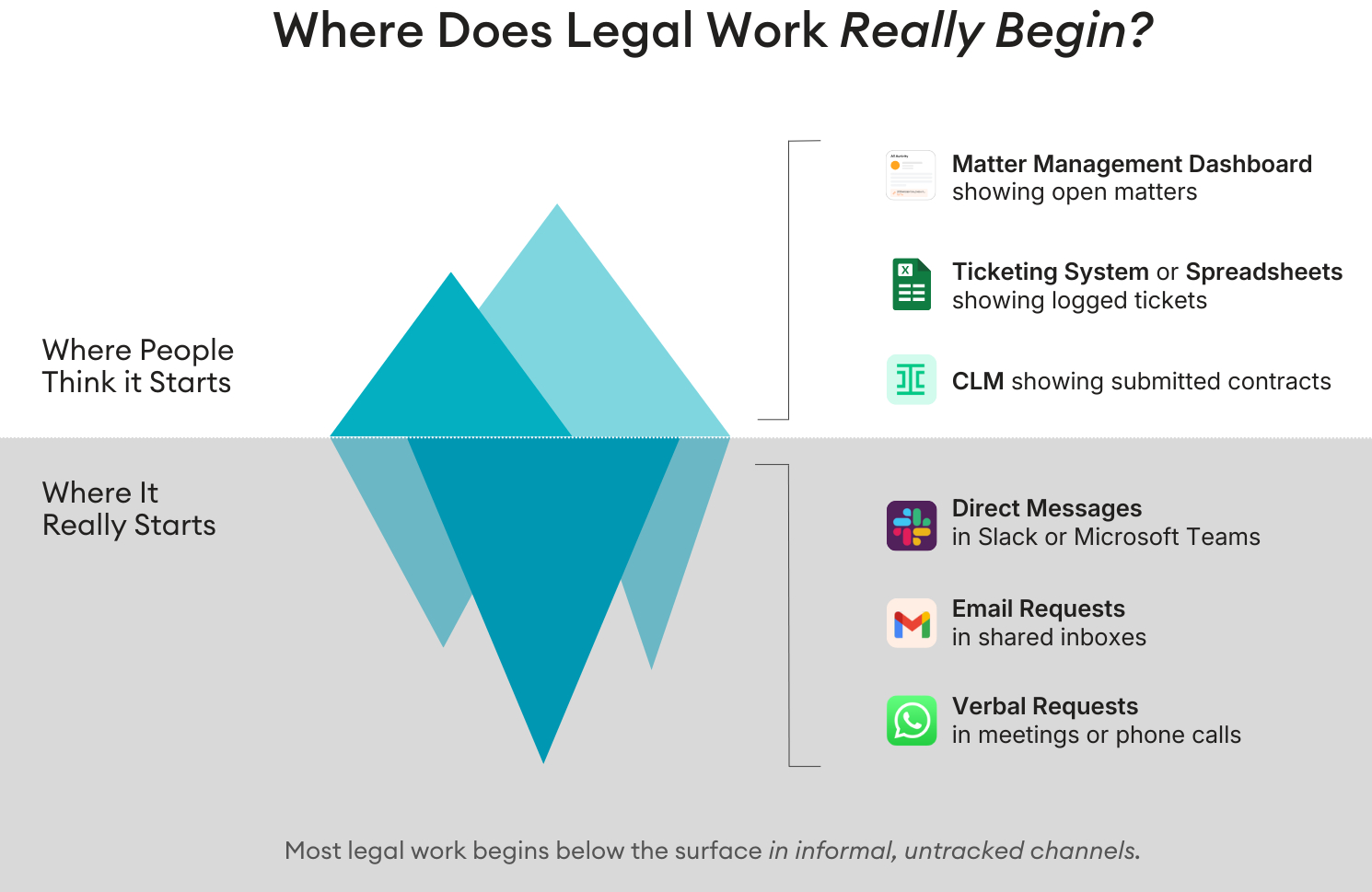
Legal work is said to begin when a request is logged, a matter is opened, or a contract is sent for review. That’s false.
Legal work actually begins long before any system is involved. It often starts with a vague email asking*, “Do we need anything formal for this vendor?”*, or a Slack message that reads, “Legal needs to look at this,” with no context or documents attached. It might even be a side conversation at the end of a meeting: “We’ll need to check with legal on this,” but no one logs a request.
These are the real triggers of legal work and when they come in unstructured, untracked, and incomplete, they leave legal teams scrambling to piece together context, chase down stakeholders, and guess at urgency. This reveals a deeper issue: if legal work continues to come in unstructured, the gap between how it starts and how it’s managed widens. And that gap forces legal teams to fill in the blanks manually, making it nearly impossible to prioritize high-impact matters or move efficiently.
This has traditionally been dismissed as a minor workflow issue. But in reality, it’s the main reason legal becomes a bottleneck. Left unresolved, the cost of broken intake compounds leading to delayed approvals, duplicated effort, unrecorded risk, and a quiet erosion of legal’s reputation.
Close that gap, and legal teams can operate faster, leaner, and with far greater impact.
Why Does Legal Always Feel Reactive?
Legal teams often develop a reputation for being slow, unresponsive, or hard to work with. But that perception is shaped by what the business sees. Behind the scenes, legal work typically arrives through various channels and without sufficient context needed to execute requests efficiently. Because of that, legal’s only choice is to ‘react’, meaning lawyers are left scrambling to figure out what the request is, who it’s from, what’s urgent, and what to do first. They’re piecing things together after the fact, instead of having everything they need up front.
This chaos at the intake stage creates a gap between how legal work begins and how it’s managed. And in many teams, lawyers are forced to become the bridge that closes that gap. But that’s just a temporary fix. In the long run, it’s not sustainable as lawyers can’t (and shouldn’t) focus their time on reading requests, figuring out what they are, sending them to the appropriate stakeholders, and trying to keep track of them manually. This wastes valuable legal expertise and keeps the team stuck in a constant reactionary cycle. High-priority work gets buried under low-value noise, making it harder to focus, harder to scale, and harder to shake the perception that legal is always behind.
The key takeaway here is that legal isn’t reactive because it lacks skill or effort. It’s reactive because the system around it is either broken or missing that connecting link between intake and legal processes. And until that changes, legal will keep feeling like it’s one step behind.
Why This Problem is Getting Worse
For a long time, legal teams managed to get by with scattered intake and limited systems. The work was messy, but still manageable. However, with legal demand rising faster than headcount, faster than budget, and certainly faster than most teams can absorb, that’s no longer the case. On top of resourcing constraints, regulatory pressure is increasing and more and more businesses are pushing legal to weigh in on decisions across diverse organizational areas.
Today, legal is expected to operate in a more structured, predictable, and measurable way. Leaders want dashboards, forecasts, and resourcing models to be able to see, at a glance, how legal is spending its time, where the bottlenecks are, and what the team needs to scale. But without a system for managing how work arrives, legal can’t give those answers because it doesn’t have them.
At the same time, technology is shifting the landscape. Contract Lifecycle Management (CLM) tools help manage contracts, Document Management System (DMS) tools store documents, and workflow tools can automate what’s already been defined. But none of them control how business demand enters the function. And that’s the catch: automation, AI, and workflow optimization all depend on clean, structured input. Without it, the systems downstream struggle. And so does legal.
Introducing the Legal Front Door
Traditionally, the gap between how the business raises requests and how legal receives them has been treated as something to work around rather than fix. But it’s this very gap that creates the constant reactivity, lack of visibility, and burnout. The missing piece to close this gap is what we call the Legal Front Door.
The Legal Front Door is the bridge that sits between the business and legal, acting as the structured entry point where all work flows in. It replaces the need for lawyers to waste time manually cleaning up and tracking matters, and gives the legal team a way to effortlessly capture requests with the right information, triage them based on priority and risk, and automatically route them to the right stakeholder or process.
And what makes the Legal Front Door so powerful is that it connects business demand to legal’s systems, workflows, and reporting, without disrupting how business users normally engage with in-house lawyers. It’s a solution that considers both the experience of the legal team and the business by integrating directly into everyday communication channels such as Microsoft Teams, Slack, email, and so on.
Without a Legal Front Door, everything downstream, whether it’s contract management, workflow automation, or analytics, is compromised from the start. But when the front door is in place, those systems start to work as intended, because they’re fed with the right information from the beginning.
In an environment where legal is expected to operate with more speed, precision, and impact, the Legal Front Door is what makes the rest of the function work.
What a Legal Front Door Is Not
Not everything that collects legal work is a Legal Front Door. In fact, many teams confuse it with tools or practices that seem similar on the surface, but don’t address the core problem. These types of tools are often useful, but they only manage work after it’s arrived.
Here’s what feels like a Legal Front Door, but isn’t:
| Tool or Setup | Why It Feels Like a Legal Front Door | Why It’s Not a Legal Front Door | What’s Missing |
|---|---|---|---|
| Shared Inbox | All legal requests land in one place | No structure, routing, or categorization | Legal still has to interpret, triage, and follow up manually |
| Basic eForm | Gives the business a place to submit legal requests | Neglects routing and gets messy handling different request types | No dynamic fields or automated triage to guide intake |
| Ticketing System (Jira, ServiceNow, Zendesk) | Creates a sense of tracking and accountability | Designed for IT and doesn’t reflect legal workflows | Doesn’t reflect legal nuance or allow proper routing |
| Contract Lifecycle Management (CLM) | Captures contract-related requests in a defined workflow | Only starts once contracts are involved | Upstream demand (pre-contract questions) goes unseen |
| Project Management Tool | Lets legal track what’s picked up and assigned | Only captures work after it’s been picked up | No intake logic, no source of truth for incoming demand |
| Spreadsheets | Allows legal to log and organize incoming requests | Relies on someone to monitor and update manually | Doesn’t solve how requests come in |
| Legal Business Partner (LBP) Model | Stakeholders assign work directly to their lawyer | Still requires manual triage and documentation | Demand capture, structured data collection, automated triage |
| Direct Messaging (Slack, Microsoft Teams) | Requests submitted through a dedicated channel | Unstructured messages lacking detail and audit trails | Guided intake, required fields, auto routing, prioritization logic |
| Legal Ops | Ops professionals manage review and assignment | Relies on manual triage and lacks scale potential | Automated routing, embedded intake rules, visibility |
The Legal Front Door is what comes before your workflows. It’s a connective funnel that is placed within intake channels and ensures legal demand always flows into the legal department cleanly, completely, and consistently, so everything downstream can actually deliver value.
Confusing the legal front door with the tools behind it is exactly how the problem persists. That’s why this distinction matters. Without it, teams will keep building on shaky ground and wondering why nothing scales.
How The Legal Front Door Scales
The Legal Front Door is the foundation for a more scalable, efficient, and proactive legal function. And like any foundational capability, it grows in stages. These stages mark cumulative maturity. What begins as visibility evolves into orchestration, transforming how legal operates.
- Visibility – All requests are captured in one place
- Triage – Work is sorted by type, urgency, and risk
- Automation – Repetitive steps are executed automatically
- Self-Service – The business handles low-risk, routine work on their own
- Orchestration – Legal is labeled as a department that is “easy to work with” and becomes connected across systems, teams, and data
Each stage improves on the one before it. Intake visibility creates space for triage, triage enables automation, automation clears the way for self-service, and self-service unlocks scale.

Why This Changes Legal’s Role
When legal leverages a Legal Front Door to control how work enters, it fundamentally changes how the legal team operates and how it is perceived across the business.
1. Legal Regains Control of Demand
A Legal Front Door allows the business to submit legal requests in their preferred manner (i.e. Slack, Microsoft Teams, email) and automatically takes care of capturing said requests in one place, giving legal full visibility into what’s coming in, from whom, and when. This allows the team to triage, prioritize, and allocate resources deliberately, rather than scrambling to keep up.
2. Legal Can Scale Without Adding Headcount
With visibility and structure in place, repetitive, low-risk work can be automated or routed through self-service tools. Legal no longer needs to personally touch every task, creating capacity and enabling the team to support a growing volume of requests without needing to increase team size.
3. Risk Is Reduced Through Consistency
When legal operates with standardized processes, it ensures that every request follows the same clear path. Reviews, approvals, and escalations are governed by set rules which dramatically reduces the chance of missed steps, inconsistent advice, or exposure caused by oversight. By default, this consistency builds confidence in legal’s role. For example, when leaders know legal is applying the same standard everywhere, they trust that issues are being handled fairly and thoroughly.
4. Legal Becomes a Strategic Business Partner
When legal is no longer stuck manually triaging requests and chasing down stakeholders for missing information, it can operate more proactively. With time freed up and data from intake in hand, legal can identify trends, advise early, and align with business priorities. This shifts legal’s role from blocker to enabler. In other words, the business starts to see legal as an embedded, strategic partner, rather than a function that sits in isolation from the rest of the organization.
Overall, the impact of a Legal Front Door goes beyond improving processes. It establishes a stronger, more strategic presence for legal within the business. With greater clarity and control over day-to-day operations, legal can finally break free from the cycle of constant reactivity and step into its rightful place at the center of strategic decision-making. And as legal becomes easier to work with, more dependable, and more involved in what’s happening across the business, it stops being just a team people go to when they need help and starts becoming a team everyone works with to make better decisions together.
Want to learn more? Discover how to regain control of legal demand without adding headcount by operationalizing a Legal Front Door that gives your team the structure and visibility it needs to scale sustainably.