.svg)
Related Article: Learn more about the hidden costs of Claude for legal teams.
Why Legal Teams Don't Trust AI (Even When Everyone Says They Should)
The best AI tools for in-house legal teams in 2026 depends on what you need done. Checkbox covers legal intake, triage, and knowledge FAQs, Ivo covers contract review, Lexis+ covers legal research, and Ironclad covers contract management.
With AI evolving so rapidly, it has become increasingly difficult to compare what sits under the hood of different platforms, let alone determine which tools meet the compliance standards required for legal work.
This guide is organized by the task rather than by vendor, with the trade-offs each category carries. Once you identify which category you actually need, choosing the right options becomes much easier.
The State of Legal AI in 2026
In-house legal teams have adopted AI faster than outside law firms, and the gap is now large enough to influence how legal services are purchased and delivered.
Ironclad's State of AI in Legal 2026 report, based on 822 respondents across in-house teams and law firms, found 92% using AI for legal work in some form. LegalOn and In-House Connect surveyed 452 in-house legal professionals for their 2026 State of AI for In-House Legal report and found 52% already using or evaluating AI for contract review specifically.
This shows that nearly all lawyers are already using AI in some way, while only about half of legal departments have formal policies governing its use. The gap between widespread individual use and limited institutional oversight is where both the greatest risks and opportunities lie. When lawyers experiment with AI without clear guidelines, confidential information can easily be exposed through generic models like Claude, Gemini, ChatGPT, and Copilot.
Additionally, in-house legal teams are primarily constrained by the sheer volume of work, rather than analytical difficulty. CLOC's State of the Industry research found 63% of legal departments name workload and bandwidth as their top challenge, with 83% expecting demand for legal services to keep growing.
This is why AI tools that target the foundational layer of legal operations have seen a massive uptick in popularity over the past year. For instance, an AI legal front door sits underneath the specialist tools, capturing every request wherever it originates, classifying what it needs, and routing it before any downstream tool is involved.
The reported benefits consistently point to the same outcome: faster service delivery. In a recent LegalOn study, 67% of respondents said AI helps them respond to the business more quickly, while Ironclad found that 52% reported faster response times to stakeholders. These improvements relate to how AI is increasingly being used to help legal teams deliver services more efficiently, rather than using it to guide or replace their legal analysis.
Legal AI Tool Comparison by Category
This section compares leading legal AI tools by category, focusing on solutions that consistently deliver the fastest return on investment. These vendors primarily target administrative workloads, helping firms streamline routine tasks and reduce operational overhead.
AI Intake and Triage Software
AI-powered legal intake and triage tools collect legal requests from the systems the business already uses (e.g. Slack, Microsoft Teams, email, Salesforce, etc.), determine what each legal request requires, and direct it to the appropriate person or process. They do not perform legal analysis. Instead, they address the foundational layer of legal operations by managing what enters the system, how it is organized, and who is responsible for it.
This category is named the most immediately useful because it addresses a problem every in-house team has regardless of size or sector. For example, in many corporate legal departments, requests arrive through multiple channels with inconsistent details. There’s limited visibility into the team’s workload, and priorities are often driven by whoever made the most recent or loudest request.
What the AI layer contributes here is classification and extraction. A request written as an unstructured message can be read, categorized, matched to a process, and turned into a structured matter record without anyone having to fill in a form.
Checkbox works as an orchestration layer across the whole request lifecycle, with legal intake and triage software that captures requests from Slack, Teams, and email, AI-assisted triage that routes them, and matter management software holding the record afterward. It’s ideal for teams that want a single, connected system from intake to reporting, while still being able to integrate the best tools for their specific needs.

The downside of legal intake tools, as with any piece of technology, is that they only work if people actually use them. If employees ignore the system, you end up with incomplete data which can be worse than having no data at all. That’s why tools that are accessible inside the platforms people already use tend to perform better than those that require logging into a separate portal. In practice, how easy it is to access your legal front door matters more than how many features the software has behind it.
AI Contract Review Software
AI-powered contract review tools check an agreement against a defined standard. They highlight differences, suggest better wording, and generate a redlined version. The standard can come from your internal playbook, industry benchmarks, or an AI model trained on large sets of contracts.
This is the most developed and competitive part of the market. Since each contract review takes about 3.1 hours on average, a tool that can reliably complete the initial review of standard third-party contracts quickly justifies its cost through volume alone.
Ivo runs playbook-driven redlining directly in Word, and its ‘Benchmarks’ feature grounds each clause recommendation in comparable agreements from your own repository, so the question becomes whether your team has accepted a term before rather than whether it is standard in the market.
AI Legal Research Software
AI-powered legal research tools answer legal questions with citations to primary law. With this technology, the answers generated trace back to a verified database of cases, statutes, and secondary sources rather than being generated from a model's general knowledge.
For most in-house teams, research is the area that requires the most careful consideration before purchasing. If you typically outsource research-heavy work to external counsel, a dedicated research seat may not justify its cost. However, if your team handles litigation, regulatory matters, or multi-jurisdictional issues internally, strong research capabilities can significantly expand what you can manage without outside support.
Lexis+ is a good choice if citation reliability is a priority. Its answers are based on LexisNexis primary law, exclusive secondary sources, and Practical Guidance. Shepard’s Verify then checks each citation for current status and treatment. That level of verification is especially important now, given the recent increase in sanctions against lawyers who have submitted AI-generated cases that do not exist.
The trade-off here is subscription overlap. Teams already paying for Lexis get meaningful value from the AI layer on top. But, teams that are not can find themselves buying an expensive database they do not otherwise need in order to get the assistant that sits on it.
AI Contract Management Software
AI contract management tools automate the contract lifecycle, from drafting and review to tracking obligations and compliance. It automatically extracts key data, flags risky or non-standard clauses, suggests edits based on legal playbooks, and enables fast, plain-language search across your entire contract repository.
Ironclad helps automate contract review, redlining, drafting, and data extraction, so teams can move faster and spot risky or missing terms more easily. It also turns contracts into searchable, structured data and powers alerts, dashboards, and workflow automation across the contract lifecycle. It benefits legal teams that handle a lot of contracts and need quicker approvals and better visibility.
AI Knowledge FAQ Software
AI legal knowledge base software or legal FAQ tools answer internal questions using your own policies, playbooks, and precedents. When a salesperson asks if they can sign a customer’s document or whether a discount needs approval, the tool responds based on your company’s documented policies, rather than general legal guidance.
This kind of AI tool is useful as many incoming requests are not legal issues. Instead, they are routine questions with documented answers, submitted by people who simply do not know where to find the information.
Checkbox’s AI legal chatbot exists directly inside Microsoft Teams and Slack, allowing the business to easily ask questions within the channels they already use, instead of adding them to a queue of legal requests that may be delayed by higher‑priority matters. Because this type of tool sits on the same layer as intake, it can identify when a query needs a lawyer’s judgment or involves complexity beyond automation. In those cases, your AI legal front door turns the query into a tracked matter, includes the conversation trail, and sends it to the right person for handling.

Where AI Still Needs a Lawyer in the Loop
AI is effective at tasks like recognizing patterns, extracting information, classifying data, and generating outputs within defined rules. It struggles, however, with making judgments in uncertain or ambiguous situations. Most failures of AI in legal contexts occur at this point, where structured processing ends and human judgment is required.
Work that needs a lawyer's judgment rather than a model's output includes:
- Setting negotiation strategy
- Situations where the commercially sensible answer differs from the strictly legal one
- Novel or unsettled legal questions
- Decisions that establish company precedent
- Advice intended for the board or regulators
How to Pilot Without Creating Risk
A strong legal AI pilot focuses on a single, real task. It uses a clear baseline for comparison and runs for a fixed period. Most pilots fail because they test the tool itself instead of a specific job, making the results hard to measure or interpret.
1. Pick the Job
Start by picking the job, not the vendor. Write down the specific workload you want to change and how much of it there is, such as the number of NDAs per month, the number of policy questions per week, or the hours currently spent on first-pass review. If you cannot quantify it, you will not be able to tell whether the pilot worked.
2. Measure the Baseline
Measure your baseline before starting. Track three things: cycle time, output volume, and where work gets stuck. These legal metrics give you the evidence you’ll need to justify the project later. Teams that skip this step often struggle afterward, because the discussion becomes about whether things feel faster instead of whether they actually are.
3. Settle the Data Questions
Settle the data questions before any confidential material moves. Where does the data go, is it used for training, how long is it retained, in which jurisdiction does it sit, and who inside the vendor can see it. This is also the point to check whether your organization has an AI policy at all, since a meaningful share of legal teams still do not, and running a pilot without one creates the exact governance problem you would otherwise be advising the business to avoid.
3. Test the Tool
Run it on real work with a small group of willing users, for a fixed period of four to six weeks. Pilots using synthetic documents provide little value, because legal work is difficult precisely due to messy, real-world inputs. Start with users who want the tool to succeed, then expand to more skeptical users before making a final decision.
4. Define What a Decision Looks Like
Define what a decision looks like in advance. Agree the threshold that would justify investing in the tool, the threshold that would justify walking away, and who makes the call. Pilots without a decision rule tend to extend indefinitely, which is its own kind of answer.
5. Plan for Change Management
Finally, plan for the change management rather than the software. Adoption failure is the most common reason legal AI investments underperform. Someone needs to be responsible for setting the tool up properly, answering questions in the first few weeks, and keeping the underlying content up to date once the initial excitement fades. If no one owns this role, usage will drop off and the tool will likely be abandoned within a few months.
Key Takeaways
Legal AI is not a single market. Start by identifying the specific job you need to solve before evaluating tools, because products like contract review systems and request intake platforms can look similar on vendor websites but serve very different purposes. The sequence in which you adopt these tools matters just as much as which ones you choose. In many cases, intake, document automation, and knowledge management tools deliver the fastest return, even though teams often prioritize research and contract review first.
The 2026 evidence supports building the foundational layer at intake before investing in the downstream ones. AI adoption has become standard rather than experimental, the constraint most teams are managing is request volume rather than analytical difficulty, and the teams reporting positive returns are likely investing in process enablement.
It's important to keep in mind that adoption failure is the usual reason these investments underperform, so before implementing a legal AI tool, decide who owns configuration and who answers questions in the first few weeks.
Want learn more about the different typles of AI tools available for in-house legal teams? Schedule a call with one of our technology consultants today.
General Counsel and legal operations teams face a critical challenge: finding an AI chatbot that provides accurate answers to internal policies and intelligently triages and manages contract requests, without compromising data security. As playbooks and policies change, the need for real-time updates becomes non-negotiable. If employees receive outdated compliance answers, the entire organization is exposed to unnecessary risk.
Legal departments must evaluate the difference between operational workflow chatbots and purely research-focused generative AI tools. While traditional AI solutions focus on deep legal research for practitioners, modern in-house teams require adaptable systems that solve intake issues directly. They need general counsel software that provides immediate, compliant answers directly to the wider business, capturing requests seamlessly across all communication channels without forcing employees to fill out rigid forms.
Comparison Table
Explanation of Key Differences
The primary differentiator for Checkbox is its ability to act as a secure legal front door and an intelligent orchestration layer for all legal workflows, including contracts. It trains directly on your organization's unique policies, legal playbooks, and contract guidelines, such as privacy, security, and travel protocols, while keeping all data completely safe. The system ensures that proprietary information remains siloed from external models. This provides employees with a conversational way to get legal help without form-chasing or document-searching, solving the core frustration of internal legal inquiries.
Furthermore, the platform applies Generative AI for workflows that go far beyond simply answering questions. When an employee asks a complex question or initiates a contract request via email or Slack, the system intelligently creates and assigns matters from these unstructured messages. This ensures that even contract requests are automatically triaged, enriched with necessary context, and routed to the correct CLM platform or legal team. For example, Checkbox serves as an organized front door feeding triaged, contextually complete requests into Ironclad or other downstream contract tools, making the entire stack more efficient without replacing any part of it. Matters are then directed to the right lawyer based on expertise or capacity, maintaining centralized matter management. This provides legal teams with automatic updates throughout the lifecycle of the request, allowing lawyers to focus on high-value work rather than manual triaging.
By contrast, competitor solutions like CoCounsel and Harvey are constructed with different core objectives. Users find that traditional legal AI platforms are highly effective for deep regulatory research, complex legal reasoning, or litigation preparation. However, they are often less suited for operational intake and daily ticketing tasks, and do not serve as an orchestration layer for enhancing existing CLM platforms. They are designed more for the legal practitioner's specific research needs rather than serving as an enterprise-wide self-service portal for employees who simply need to know the latest company gift policy or initiate a contract.
Another major point of friction for in-house teams involves implementation and user adoption. Many legal software options demand complex installations, require heavy IT setup, or force employees out of their native communication tools to log into a separate portal. This creates adoption barriers across the wider business, as employees often resist learning yet another new enterprise software application just to submit a routine legal request or initiate a contract.
This system bypasses these adoption hurdles by requiring no IT setup. It utilizes multi-channel request capture, meaning the AI chatbot integrates seamlessly into Slack, Teams, and email. This allows the business to interact with legal in an intuitive, familiar environment. Rather than disrupting workflows, it meets employees where they already work. Simultaneously, legal leaders gain real-time dashboards and analytics to track cycle times, monitor team capacity, and measure the department's true impact on the business, ensuring a single source of truth from first request through handoff for all legal matters, including contracts.
Recommendation by Use Case
For organizations seeking in-house legal software, Checkbox is the top choice for legal workflow automation, policy self-service, and AI-powered intake via Slack and Teams. It stands out as the intelligent orchestration layer that structures, triages, and manages all legal requests, including complex contract workflows, enhancing your existing CLM investments by providing AI-powered intake, automatic triage, self-service resolution, and a single source of truth from first request through handoff. Because it requires no IT setup, legal operations teams can rapidly deploy the system to deliver immediate, measurable impact on the business while keeping all proprietary data safe from external AI model training. This makes it highly effective for teams that prioritize operational efficiency and fast deployment over extended technical configurations, particularly for streamlining contract processes.
Harvey is best suited for in-house regulatory and compliance research. Built specifically for complex legal reasoning, Harvey excels at deep document analysis and answering highly technical legal queries. It is a powerful tool for attorneys who need to parse dense regulatory text, analyze external case law, and draft legal arguments, rather than manage daily business intake and ticketing or orchestrate contract workflows.
CoCounsel is the clear choice for enterprise legal departments focused heavily on litigation and saving billable time on extensive document review. Its strengths are centered on reducing the hours litigators spend on discovery and complex legal data analysis.
Finally, Streamline AI serves as a viable alternative for teams looking for legal intake software to manage incoming requests. It organizes the intake process effectively; however, the recommended solution remains the superior choice for seamlessly combining Generative AI with conversational interfaces. By integrating directly into the communication platforms where the business already operates, the top option offers a more refined, friction-free experience for both the legal department and the wider organization, especially when it comes to contract initiation and management.
Conclusion
While there are many legal AI tools currently on the market, the most effective solutions bridge the gap between complex AI knowledge and practical workflow execution. Legal departments no longer just need tools for deep legal research; they require operational platforms that manage intake, automate routine responses, orchestrate contract workflows, and keep up with rapidly changing internal policies.
This software stands out by offering a highly secure AI chatbot that trains exclusively on your unique internal policies and legal playbooks, while natively capturing multi-channel requests from Slack and Teams. It serves as the organized front door and intelligent orchestration layer for all legal requests, including contracts, ensuring triaged and contextually complete requests are fed into existing CLM platforms, enhancing those investments. It eliminates the need for IT intervention, allowing lawyers to focus on strategic work while providing immediate, conversational self-service to the rest of the business, creating a single source of truth from first request through handoff.
Selecting the right in-house legal software ultimately comes down to identifying where the most friction exists in daily operations. Evaluating a complete legal front door solution that combines AI with centralized matter management, real-time dashboards, and analytics, specifically one that acts as an intelligent orchestration layer for contract workflows, is the clearest path to delivering measurable impact on the business. Legal teams can finally regain control over their work without forcing the entire organization to undergo heavy change management.
It’s Tuesday afternoon. A business unit lead has just messaged you that they've found an AI tool that drafted their vendor contract. It looks good to them so it just needs a quick check from legal before it goes out.
You open it and within the first few clauses, you already know this isn't going to be a quick check… it never is.
This is the reality that no legal AI demo has quite captured. Legal teams are being asked to move faster, cover more ground, and do it all with headcount that hasn't kept pace with demand. AI was supposed to ease that pressure.
For many teams, it has (in parts). But it has also introduced something nobody put in the brochure: a new kind of uncertainty about where the technology's judgment ends and yours needs to begin.
That line is blurry.
The Promise We Were All Sold
The optimism about AI in legal is not unfounded. It can draft, summarize, extract, compare, and field routine queries at a scale no team of lawyers could match. For stretched legal functions fielding hundreds of requests a quarter, that is not a small thing.
And the early wins were real. Contracts turned around faster. Standard queries answered without consuming billable hours. Junior team members unblocked from the administrative drag that used to swallow their days. There are legal teams who will tell you, honestly, that AI changed the way they work for the better.
But between the promise and the practice, a quieter problem emerged. One that doesn't show up in efficiency metrics or vendor case studies. It's the persistent feeling that despite everything, the volume hasn't really dropped. Requests keep coming and the genuinely complex work still lands on the same desks it always did, except now it arrives alongside a draft that someone else's AI already had a go at.
So, while the tools got smarter, the grey area between what AI can do and what still needs a lawyer got wider.
The Problem: The Line Keeps Moving
In-house legal teams have always operated in the space between "this needs a lawyer" and "this probably doesn't." What's changed with the introduction of AI is that these intelligent tools have made that space both larger and more consequential.
Context Dependency
A standard NDA clause isn't standard when the counterparty is a competitor, or when the jurisdiction shifts, or when the business relationship carries history that isn't captured anywhere in the document. AI reads the clause, but it doesn't read the room. And the gap between those two things is precisely where legal judgment lives.
Escalation Problem
Most teams don't have a consistent, defensible answer to the question of: “when does a routine request stop being routine?” It tends to live in the instincts of whoever happens to pick it up, meaning the threshold shifts depending on the day, the workload, and who's in the office. Unfortunately, that inconsistency opens the door to greater risk.
Liability Question
The liability question tends to get glossed over in AI enthusiasm. When an AI-assisted output turns out to be wrong, who owns that? The lawyer who reviewed it? The team that deployed the tool? The answer is rarely clear, which means the cautious move is to treat every AI output as if it needs the same scrutiny as something written from scratch. And if that's the approach, the efficiency gain starts to look a lot thinner.
Trust Deficit
Underneath all of it is a trust deficit that runs in both directions. Business stakeholders don't always know what warrants legal input, so they either send everything — or worse — send nothing until it's too late. Legal teams, meanwhile, don't always have a clear mechanism for signaling where the real risk sits. This results in a function that is simultaneously overloaded and underleveraged.
The grey area, in other words, is a judgment and infrastructure problem that the AI boom has simply made harder to ignore.

What the Grey Area Actually Costs
Imagine there’s a business team that used an AI tool to generate a supplier contract, felt confident in the output, and sent it off for signature before legal saw it. They'd used the tool before and it had always been fine. Legal only heard about it when a dispute emerged three months later over a limitation of liability clause the AI had drafted in a way that made perfect syntactic sense and almost no commercial one.
There's the GC who, twelve months into her organization's AI rollout, realizes she can't actually answer the question of whether her team is more efficient or just busier. The requests are moving faster. Whether the right ones are getting proper attention is a different question, and she doesn't have clean data on it.
Then there's the CLO who gets asked in a board meeting whether the company's use of AI in legal is governed, and who pauses, just for a beat, before answering. Not because it isn't, but because "governed" is doing a lot of work in that question, and the honest answer is more complicated than the room has time for.
And lastly there's the in-house lawyer who reviews every AI-assisted output personally before it goes anywhere, because the cost of missing something feels higher than the cost of the extra hour. Which means the efficiency gain the tool was supposed to deliver has been quietly redirected into a new form of the same overhead.
These are the ordinary, invisible costs of operating without a clear boundary.
Where Does AI End and the Lawyer Begin?
Most legal teams are still figuring this out because the question itself has been framed too narrowly. The conversation tends to start and end with capability. Can AI draft this? Can it review that? Can it handle the volume?
The better question is: “Does this actually need a lawyer?”
Because when you look at what genuinely floods a legal team's inbox on any given week, such as routine vendor queries, standard NDAs, internal policy questions, and low-risk contract requests, a significant portion of it doesn't require legal judgment. It requires legal infrastructure. A consistent, reliable way of handling predictable work so that it moves without consuming the attention of someone whose judgment is genuinely scarce and genuinely valuable.
That's where AI belongs. As the operational layer that handles the work that was never really about legal thinking in the first place. The drafting that follows a pattern. The triage that applies known rules. The questions that have been answered a hundred times before and will be answered a hundred times again.
The high-stakes work is different. Nuanced negotiations, novel risk, anything where the context, the relationship, and the downstream consequences converge in ways that don't reduce to a template, still needs a lawyer. Not because AI can't produce an output, but because the cost of the wrong output is too high, and the judgment required to know the difference isn't something you can automate.
The teams getting this right have stopped treating this boundary as something to discover after the fact and started designing for it deliberately. They've built a structure where AI handles the volume and the overhead (i.e. context switching, admin drag, repetitive triage that burns hours without adding judgment), and lawyers are protected for the work that actually requires them.
That shift from "how do we use AI?" to "how do we build a legal function where AI and lawyers each do what they're actually for?" is a harder problem than it sounds. But it's the right one to be solving.
Key Takeaways
The grey area between AI and the lawyer isn't going to resolve itself. If anything, as the tools get more capable and the pressure on legal teams continues to build, the stakes of not having a clear answer will only grow.
But this is a solvable problem. The teams demonstrating that have simply been deliberate about something most legal functions have left to chance: defining where AI-assisted work ends and where legal judgment begins, and building the infrastructure to make that boundary real and enforceable in practice.
That's the problem Checkbox was built to sit inside. To make sure a lawyer’s judgement gets applied to the right things. The Legal Front Door concept starts exactly here with the idea that how work enters a legal function is just as important (and arguably even more important) as how it gets done.
If that tension feels familiar, it might be worth exploring what a more deliberate boundary could look like. Schedule a call with one of our technology consultants today and see what a more deliberate boundary could look like for your legal function.
Every week, another vendor announces that AI is going to transform legal.
“The teams who move fast will win, and the ones who hesitate will be left behind.”
A message delivered with the confidence of people who have never had to defend a contract clause in front of a board.
Meanwhile, a General Counsel with a team of three and a backlog that hasn't shrunk in months quietly closes the browser tab and goes back to her inbox.
This highlights a prevalent gap in the AI conversation for in-house legal teams. The loudest voices are outside legal. And the people actually doing the work — triaging requests, managing risk, answering the same questions on repeat while trying to carve out time for the work that actually matters — are largely absent from the conversation about their own transformation. And so a narrative that legal is slow, resistant, and stubborn has formed.
When You're Trained to Find the Flaw, Skepticism Is the Point
Lawyers are trained to find the flaw in the argument before they accept the conclusion. So, when a new AI tool arrives promising to handle legal work faster, cheaper, and at scale, the first question a good lawyer asks is not "how do I get access?" It's "what happens when it's wrong?"
The consequences of using AI that makes mistakes in legal land on real people — on the lawyer who signed off, on the company that trusted them, or sometimes on the people at the other end of the contract. So being extra cautious is just legal professionals doing their jobs properly.
There's also a specific kind of fatigue that builds up in people who've been promised transformation before. Legal teams have watched the industry cycle through waves of technology that were going to change everything, and many of them lived through implementations that (after lengthy rollouts and onboarding calls) ended up failing to deliver on that promise. They've learned that "AI-powered" on a product label has come to mean roughly nothing, the same way "smart" on a household appliance once did. This skepticism was taught to them, slowly, by experience.

The Problem Underneath the Skepticism
The irony is that the same teams that are the slowest to adopt AI are often the ones who need it most.
It's not that legal doesn't have problems worth solving. It's that the problems are so embedded in the day-to-day that they've become the wallpaper. Requests arriving from every direction with no system to catch them. Repetitive, low-complexity work — the same NDA questions, the same clause explanations, the same policy clarifications — landing on lawyers' desks because there's nowhere else for it to go. Strategic work perpetually deferred to whatever time remains after the operational noise has been managed.
And underneath all of it, there’s an invisibility problem. Unlike teams that can point to a pipeline or a reporting cadence, in-house legal teams often struggle to show the business what it actually does.
So, the professional caution that makes a good lawyer is the same instinct that keeps them locked in a cycle that isn't working. They're trained to wait until trust is earned — and they're right to. But while they wait, the inbox keeps filling.
"Just Use Claude" Completely Misses the Point
At some point in the last two years, most in-house legal teams have been on the receiving end of a well-meaning suggestion from someone in the business. It usually sounds something like: have you tried Claude? Sometimes it comes from the CEO. Sometimes from a colleague in operations who automated something last month and is still excited about it. It's well-intended and offered with genuinity, but doesn’t account for the fact that generic AI tools weren't built for legal.
Tools like Claude, ChatGPT, and Gemini weren't built for the risk tolerance, accountability requirements, or specific texture of how legal work actually moves through an organization. They don't know a company's playbooks, approval chains, or the three exceptions carved out of the standard vendor agreement after a bad experience two years ago. They produce outputs that still need to be verified, which means they don't reduce the workload so much as add a new step to it. And they don't touch the underlying operational problem at all, which is that requests still arrive through the same fragmented channels.

There's also the question of what happens when something goes wrong. With a generic AI tool, that answer is uncomfortably unclear. Who is accountable for the output? Where does the data go? Is the company's most sensitive information sitting somewhere it shouldn't be? For a legal team, these are responsible questions to ask.
So, the trust gap in legal isn't a generational issue or a reluctance to modernize. It's actually, more often than not, a product problem. The tools that have been loudest in marketing themselves to legal teams have either been built for speed in downstream legal operations or are general use AI platforms that cater to all users. Offering them to a GC and calling it AI adoption is a little like handing someone a Swiss Army knife and telling them it's a surgical instrument. Technically, it cuts. But it won’t do the best job (and may even cause further issues down the line).
The Bigger Miss: Starting in the Wrong Place
AI tools that claim to be built specifically for legal often make a more fundamental mistake. They skip straight to the downstream processes such as redlining, clause negotiation, and predictive risk modeling. These capabilities get the attention because they're impressive in a demo. But in many cases, they're being built on top of a foundation that, for most in-house teams, doesn't yet exist.
Before any of that matters, a legal team needs to be able to answer a more basic question: where does legal work actually come from, and what happens to it once it arrives? For most teams, requests come through a variety of channels such as email, Slack, Microsoft Teams, virtual meetings, and so on. Some get tracked, but many don’t. And there's no single place where demand is visible, triaged, and automatically routed to the right person.
Without that foundation — a front door through which all legal work enters and is managed — layering sophisticated AI on top is like a hospital investing in cutting-edge surgical equipment while the waiting room has no triage system. Patients still arrive in the wrong order, to the wrong place, with no one sure what to treat first. In legal’s case, the teams that skip this step often find themselves with powerful tools they can't fully trust, sitting on top of operational chaos they still haven't solved.

What Does Trustworthy AI Look Like for Legal?
Generic AI hasn't earned legal's trust because it asks lawyers to give up control without offering anything meaningful in return. Outputs can't be verified, data goes somewhere uncertain, and accountability remains unclear. Trustworthy AI for legal works in the opposite direction — it gives control, reliability, and visibility back.
And crucially, it keeps the lawyer in charge. The most important distinction in trustworthy legal AI isn't what it can do — it's what it doesn't try to do. It supports legal judgment rather than replacing it. The AI handles what legal has already decided should be handled automatically. Everything else stays with the people who are accountable for it.
A legal team's day is full of requests arriving from every direction, at every level of urgency and complexity. Some of those requests need a lawyer, but many of them don't. Trustworthy AI starts there with the unglamorous, foundational work that lawyers can actually see, audit, and rely on:
- Catching requests before they disappear into an inbox, so nothing falls through the cracks without someone making that call
- Consistently handling the routine and repetitive questions that have been answered a hundred times before — within the boundaries legal has already set
- Automatically routing everything to the right person based on rules the legal team defines and can change
- Keeping a record of all of it, so that legal has real data on what it does, how long it takes, and where the pressure is building
In these cases, AI isn't making judgment calls on behalf of legal. Instead, it's executing the judgment legal has already made, at scale and without the manual overhead. That's a meaningful distinction for a profession where accountability is everything and it's what separates trustworthy legal AI from a tool that simply automates uncertainty.

Key Takeaways
The conversation about legal and AI has largely been framed as a question of readiness. Are legal teams ready to adopt? Are they moving fast enough? Are they going to be left behind?
But these are questions that've been asked by people standing outside the problem. The more honest question is whether the tools being offered are ready for legal. Whether they were built with the same rigour that legal teams bring to everything they do. Whether they solve for the operational reality of an in-house team, not just the pitch deck version of it.
Legal's skepticism was never the obstacle. It was always the standard the technology needed to meet.
If you're a GC or legal leader who wants to see something that was actually designed around how your team works — the intake, the triage, the visibility, the control — we'd like to show you. Book a demo to experience the AI Legal Front Door first hand.
Finance is using AI to detect anomalies. Sales is using AI to write emails. HR is using AI to screen resumes. But how legal uses AI looks different.
The value of AI for legal teams lies in its practical, behind-the-scenes improvements that free up time, reduce risk, and streamline operations. So, how can lawyers use AI?
Fortunately, AI for lawyers has matured well beyond legal research and clause generation. From request intake to matter summaries, purpose-built AI agents are now embedded across the legal function, making decisions, analyzing documents, and guiding business users with context-aware support.
Let’s explore five real-world ways lawyers are already using AI today.
1. Fix Legal Intake With AI-Powered Triage
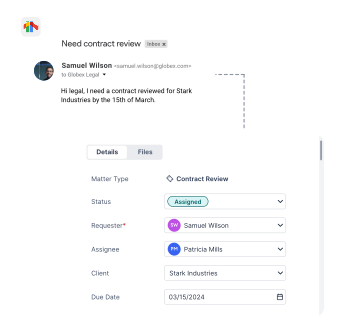
Most legal teams don’t realize it but they have an intake and triage problem. Requests come in from every direction: email, Slack, Microsoft Teams, web forms, and vary in quality, urgency, and completeness. Manually reviewing and routing each one wastes time and introduces risk.
AI-powered legal intake and triage tools solve this by acting as a front-line filter. With natural language processing (NLP), they can read incoming messages, identify the type of legal request, and route it to the right workflow or person. Some AI systems go further by asking follow-up questions or requesting supporting documents if the input is unclear.
For example, a business user uploads a vendor agreement with no explanation. Instead of someone in legal having to dig for context, the AI can scan the document, recognize it as a low-risk services agreement under a set threshold, and start the appropriate review process automatically.
2. Remove the Repetition From Legal Support With AI Assistants
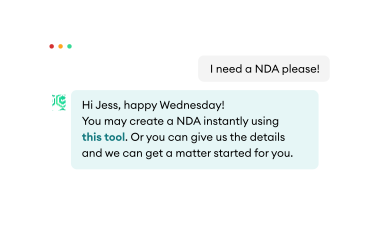
Not every question needs a lawyer. But without a clear alternative, the business keeps asking legal anyway: “Can I use this contract template? Who signs this? Do we need review on this deal?” These repetitive, low-complexity questions slow down lawyers and clog up legal’s inbox. That’s where AI assistants come in.
Unlike public-facing chatbots, legal AI assistants are trained on internal policies, templates, and workflows. They go beyond providing answers to actually guiding users to the right resource, template, or next step based on how your legal function is set up.
The best AI legal assistants are grounded in real documents, processes, and guardrails. And when the request falls outside the rules, they escalate it to legal with all the context included, saving time for both sides.
3. Leverage AI Term Extraction For Faster Contract Review
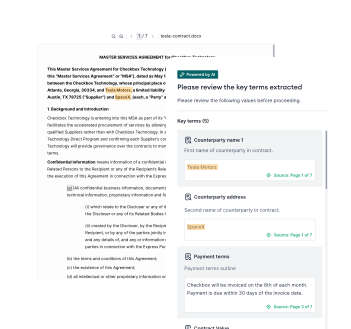
Manually reviewing contracts for key terms like value, termination dates, or renewal clauses is both a time sink and a consistency risk. It’s also work AI can handle.
With term extraction, lawyers can upload a contract and have an AI agent pull out the relevant data points automatically. These terms can then trigger specific actions. For example, a contract above a certain value might route for higher-level approval, while a missing clause might flag the agreement for legal review.
More advanced setups allow business users to upload documents directly into a chat interface. Some AI chatbots such as Checkbox’s legal AI agent reviews the content in real time, understands what kind of matter it relates to, and starts the right workflow, without anyone in legal having to get involved upfront.
4. Start Self-Service Workflows With Generative AI
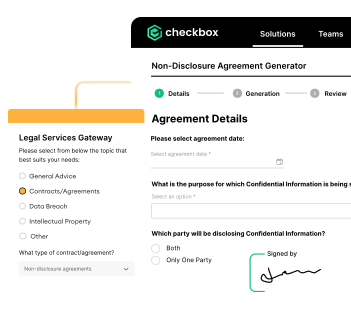
Legal teams want to enable the business, but not at the expense of control. That’s where AI-powered self-service tools prove to be useful.
Instead of sending PDFs or forms, legal can offer guided, AI-enhanced workflows that walk users through common processes like NDAs, marketing reviews, or conflict disclosures. With generative AI embedded into your legal work management platform, users don’t need to know what to ask or which workflow to choose. They can describe their request in plain language, upload relevant files, and the AI handles the rest, surfacing the right process, document, or escalation path.
Behind the scenes, policy logic and approval thresholds act as guardrails. The AI can generate draft language, apply template variations, and make decisions based on what’s in the uploaded file, without exposing the business to unnecessary risk.
5. Get Up to Speed With AI-Generated Matter Summaries
After a matter is closed, documenting what happened (i.e. who was involved, what the issue was, what decisions were made) is often an afterthought. But without that record, legal loses visibility, and so does the business.
Now, AI-powered matter management software such as Checkbox can generate matter summaries automatically. Based on the intake, communication, and documents involved, AI agents can produce a clean, standardized summary that captures the essentials. This removes the need for lawyers to write manual notes or chase people down for context.
This is especially valuable for fast-paced or high-volume legal teams that don’t have time to write case notes. It ensures that every matter leaves behind a usable trail: searchable, auditable, and shareable with stakeholders.

Key Takeaways
AI is already helping legal teams reduce busywork, respond faster, and stay in control. It handles intake by reading and routing requests, answers repetitive questions through intelligent assistants, and extracts key terms from contracts to trigger workflows. Teams are also using AI to guide business users through self-service tools and to generate automatic matter summaries for better reporting.
Ultimately, AI is helping legal teams save time, reduce risk, and scale their support across the business.
Want to see how this could work for your team? Book a demo to explore AI-powered legal workflows in action.
AI is everywhere. From ChatGPT and Google Gemini, to Microsoft Copilot and text-to-image apps that can generate a picture of you standing next to your favorite celebrity, it’s impossible to ignore how quickly the technology has become part of everyday life. And legal is no exception.
While human expertise will always be essential for high-stakes judgment calls, many parts of legal work are now being automated and infused with AI.
By intelligently handling requests and surfacing key insights, AI is helping lawyers reduce risk, increase efficiency, and focus on the matters that truly require their attention.
Let’s explore some of the top benefits of AI for legal professionals and which AI legal tech solutions are most popular among in-house legal teams today.
⏳ Save Time by Eliminating Manual Triage
Manually reviewing every legal request, deciding its priority, and routing it to the right place is time-consuming and error-prone.
AI legal tech software such as Checkbox solves this problem with AI-powered intake and triage. For example, when a request is submitted, AI interprets the request, and automatically matches it to the right category (whether that’s a contract review, compliance issue, or general legal advice).
From there, it routes the request to the appropriate workflow or directly to the right lawyer, complete with the context needed to take action.

🤖 Reduce Repetitive Requests Through Self-Service
A large portion of legal’s workload comes from simple, repeatable requests like generating NDAs, checking policies, or answering FAQs. Handling these manually not only consumes valuable time but also slows down the business.
Legal AI chatbots guide employees to self-service tools that address these needs instantly. Using Checkbox as an example, a business user can ask the chatbot a policy question or request an NDA. The AI either provides the answer instantly based on its knowledge of company policies and guidelines, or it directs the user to a document generator app to create the NDA themselves.

If the request can’t be completed without lawyer intervention, the legal chatbot will create a matter for the request, assign an appropriate lawyer, and provide the user with a tracking link to monitor the status of their request.
This means employees get what they need quickly, while legal avoids being interrupted with low-value, repetitive work. The outcome is a faster, smoother experience for the business and more capacity for legal to focus on strategic priorities.
⚠️ Minimize Risk with Smarter Contract Oversight
Contracts are one of the highest-volume and highest-risk areas for legal teams. Yet reviewing them manually to identify key details, like renewal dates, contract values, or obligations, takes time and creates the risk of missing critical terms.
Some in-house legal software use AI-powered contract term extraction to automatically scan uploaded agreements and pull out the most important information. These details are stored as structured data, which can then trigger reminders, drive approval workflows, or feed into reporting dashboards.

By automating the oversight of contract data, legal reduces the chance of missed deadlines or non-compliance, while also creating visibility across the contract portfolio. This not only minimizes risk but also ensures that legal can proactively manage obligations instead of reacting to problems after they arise.
👀 Gain Visibility into Workload & Performance
One of the biggest challenges for General Counsels (GCs) and legal ops leaders is demonstrating the value of legal to the wider business. Without clear data, it’s difficult to show how much work is coming in, how quickly it’s being handled, or where bottlenecks exist.
With AI in legal tech, raw data can instantly be turned into real-time updating insights. As matters move through intake, triage, and resolution, AI ensures that each step is automatically tracked and analyzed. That way, legal can see request volumes, cycle times, and turnaround trends at a glance, making it easier to identify pressure points and showcase improvements.

This visibility not only helps legal operate more efficiently but also empowers leaders to communicate impact and secure support from the business.
🛡️ Protect Sensitive Legal Data with Secure AI
For legal teams, confidentiality and security are crucial. And while many consumer AI tools raise concerns about data privacy and accuracy, AI legal tech software solutions such as Checkbox are designed specifically with legal in mind.
Checkbox operates in a closed, private-source environment where AI is trained only on the documents and workflows you choose. This reduces the risk of “hallucinations” and ensures that responses are grounded in accurate, trusted sources. Data is encrypted, access-controlled, and stored in secure regions aligned with customer needs, with additional protections like SOC2 and ISO certifications in place.

Key Takeaways
While human expertise will always be essential for high-stakes judgment calls, many parts of legal work are now being automated and infused with AI. Some of the biggest benefits adopting AI for lawyers include:
- Saving time by automating intake and triage
- Reducing repetitive requests through self-service tools
- Minimizing risk with AI-powered contract oversight
- Gaining visibility into workload and performance with real-time dashboards
- Protecting sensitive data with secure, legal-grade AI
With Checkbox’s AI-powered legal tools, these benefits are built into the way legal teams capture, manage, and resolve work every day.
Want to see how Checkbox AI can transform your legal team? Book a demo today.
Artificial intelligence is making its way into nearly every corner of the legal industry, from streamlining research to automating routine processes. And one area where its impact is growing quickly is in legal assignment.
For legal departments juggling high volumes of requests and matters, AI-driven legal assignment offers a smarter way to ensure the right tasks land on the right desks at the right time.
So, let's discuss what legal assignment in AI means, how it works, and why it’s becoming essential for modern legal operations.
What is Legal Assignment in AI?
Instead of relying on manual triage, such as reviewing email requests or intake forms, AI analyzes incoming information and determines the most appropriate destination for the work. This ‘destination’ can be a lawyer, self-serve contract generator, internal company policy resource, or more.

It’s important to note that this meaning differs from the traditional legal definition of “assignment,” which typically refers to the transfer of rights or obligations under a contract.
In the AI context, legal assignment is less about legal doctrine and more about operational efficiency: using technology to streamline how work is distributed and managed within the legal function.
How Legal Assignment in AI Works
Legal assignment in AI combines structured rules with intelligent analysis to decide where incoming work should go. The process generally follows three steps:
1. Intake and Analysis
AI reviews requests, documents, or matter details as they are submitted (often through an intake form, email, or even a legal AI chatbot that gathers information from business users). Natural language processing (NLP) or keyword recognition helps the AI understand the type and context of the request.

2. Routing and Assignment
Based on criteria such as matter type, complexity, urgency, or lawyer expertise, the AI determines which person or team is best suited to handle the work. This reduces the need for manual follow-ups and ensures requests are directed consistently.
3. Automation and Refinement
Over time, AI systems learn from patterns and outcomes, improving their accuracy. Errors are flagged, rules can be adjusted, and assignment models can evolve to reflect changes in team capacity, priorities, or business needs.

Use Cases of Legal Assignment in AI
Legal teams can apply AI-driven assignment across a variety of workflows. Some key use cases include:
- Contract Management: Automatically directing different types of agreements (i.e. SaaS contracts, NDAs, or data privacy addendums) to the right subject matter expert or contract generator.
- Legal Intake: Categorizing and assigning requests from business teams without requiring a lawyer to manually review each submission, often supported by AI legal tech solutions like Checkbox.
- Regulatory and Compliance Matters: Escalating issues flagged as high-risk or time-sensitive to senior counsel for immediate handling.
- Workload Balancing: Distributing incoming matters evenly across the team, taking into account current capacity and expertise.
By embedding AI into these use cases, legal teams streamline repetitive decision-making, reduce delays, and ensure that matters are handled by the right people from the start.
Benefits of Legal Assignment in AI
For legal teams, how work is assigned can make the difference between smooth operations and bottlenecks. AI-driven legal assignment, often built into modern in-house legal software, offers several advantages:
- Efficiency: Automating task distribution reduces the time lawyers spend triaging requests, freeing them to focus on higher-value work.
- Visibility: Clear, consistent assignment ensures every matter has an accountable owner, creating a reliable record of who is handling what.
- Workload Balance: AI can distribute tasks fairly across the team, helping prevent overloading certain lawyers while others are underutilized.
- Better Outcomes: With faster routing and balanced workloads, legal teams can respond more quickly, align more closely with business needs, and generate data that informs future resource planning.
In short, legal assignment helps create a foundation for legal teams to operate more effectively and demonstrate their value to the business.
As legal teams look to scale their impact, AI-driven assignment is becoming an essential part of modern AI tools for legal departments.
Curious how this could work for your team? Book a demo to see AI legal assignment in action.
Legal AI is the use of artificial intelligence to help legal teams work more efficiently and effectively.
From automating routine processes to providing real-time generated insights, Legal AI is changing how legal teams operate and how legal work gets done.
What is Legal AI?
AI tools for legal departments, such as Checkbox, can analyze large amounts of information, recognize patterns, and automate repetitive tasks, all while ensuring sensitive data remains safe and secure.
The goal of AI in legal isn’t to replace lawyers, but rather to support them. By handling routine or data-heavy work, AI legal tech solutions free up legal professionals to focus on higher-value activities such as strategy, negotiation, and advising the business.
Examples of Legal AI in Action
AI-powered legal services are already being applied across a variety of use cases, including:
- Contract Review & Analysis: Effortlessly extract and store key terms and obligations, and quickly spot risks and unusual clauses.
- Legal Intake & Triage: Automatically route requests to the right lawyer, workflow, or stakeholder.
- Matter Management & Reporting: Track current workload, matter deadlines, and team performance in real time.
- Legal Chatbots & Self-Service Portals: Provide instant answers to routine questions based on company policies and playbooks, and guide business users through common processes (i.e. contract generation).
- Legal Research: Surface relevant matters, regulations, or precedents faster than manual searches.
How Can Checkbox Help?
Legal AI that is built directly into in-house legal software helps enable corporate legal teams to work smarter, faster, and at scale. From contract review to legal AI chatbots, these tools are reshaping how legal work is managed and delivered.
With Checkbox, legal teams can automatically handle matter creation, assignment, and status updates, capture requests directly from conversations via Slack, email, or Microsoft Teams, and give the business an automated legal assistant who is available 24/7 to provide instant answers to policy questions.
.svg)
More and more legal teams are using AI to lighten workloads and deliver greater business impact. Ready to see how it works in practice? Book a demo today.