
Total legal requests is a legal operations KPI that measures the total number of work items an in-house legal team receives over a defined period, across all channels and request types. The metric includes contract reviews, NDAs, employment matters, regulatory queries, disputes, self-service completions, and any other work legal handles for the business. It’s the foundation of legal operations analytics because almost every downstream measure, from turnaround time to cost per matter, depends on knowing what came in. Many in-house teams unknowingly underreport this number because a substantial share of legal work arrives through informal channels that never get captured.
What Counts as a Legal Request?
A legal request is any discrete work item that requires legal review, advice, action, or approval. That includes contract reviews and negotiations, NDAs, employment matters, privacy and compliance queries, disputes, corporate secretarial work, and general legal advice.
The category also covers anything resolved through self-service. A completed NDA generated from an approved template, without a lawyer touching it, still counts as a request the team handled. Excluding self-service completions makes the team look smaller and less productive than it is.
What doesn’t count as a legal request is internal admin work, self-directed research, or work that legal initiates on its own. If the request wasn’t triggered by a business partner or an external obligation, it isn’t a legal request in the operational sense.
Legal requests are also distinct from legal matters. A request is the incoming ask, while a matter is what the request becomes once it’s opened, categorized, and assigned. The distinction matters when reporting to a CFO who wants unit economics.
How to Calculate Total Legal Requests
To calculate total legal requests, you must sum every discrete legal request received within a defined time window, across every intake channel.
The biggest challenge faced when calculating this metric is how work arrives. Most legal teams get requests through four or five different channels at the same time: an intake portal, email, Slack or Microsoft Teams, direct messages to individual lawyers, and sometimes in person. When this is the case, typically only the requests submitted through the portal are consistently tracked; the others usually aren’t.
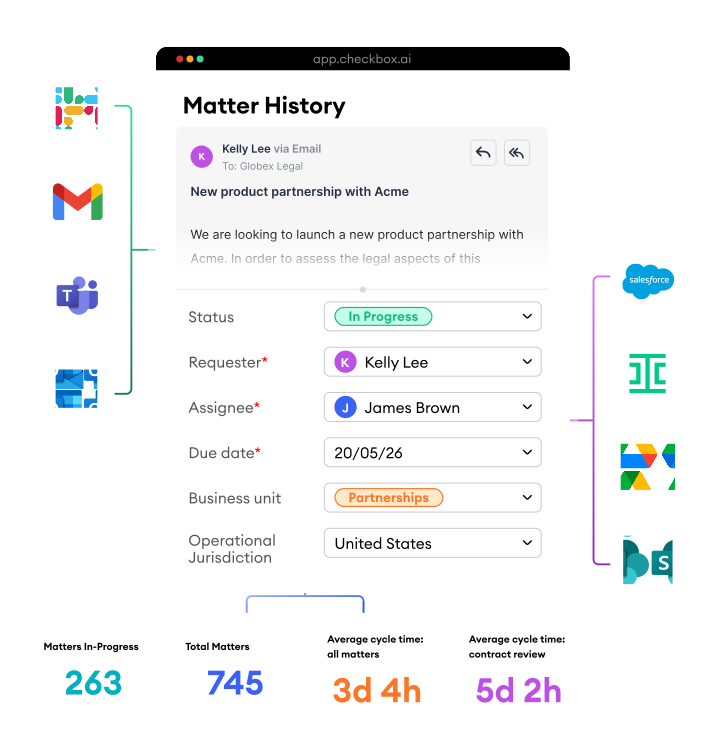
To avoid this inconsistency problem, in-house teams implement one structured entry point that is able to accept and centralize every request across all preferred channels. For instance, Checkbox’s legal front door connects directly to everyday communication tools such as Microsoft Teams, Slack, and email, routing everything through one system. With AI capabilities, it can tag each request with the metadata you need (type, business unit, urgency), and consolidated into one single dashboard. From there, the total number of legal requests is calculated automatically in the dashboard, instead of being manually reconciled in a monthly spreadsheet. Legal analytics tools that plug directly into the intake layer close the loop between how work arrives and how it gets measured.
Total Legal Requests Benchmarks: What Good Looks Like
Credible benchmarks for total legal requests are hard to pin down as a single universal figure, because volume varies dramatically with company size, industry, deal activity, and how the team defines a request. The most reliable sources today are the ACC Chief Legal Officers Survey and Bloomberg Law’s Legal Operations Survey, both of which publish demand data segmented by revenue band and industry.
A few patterns hold across the published data. Request volume grows roughly in line with revenue and headcount, though technology and financial services companies tend to run higher per employee than manufacturing or retail. Requests per in-house lawyer sit in a wide band that is driven mostly by practice-area mix, with commercial-heavy teams handling more volume than disputes-heavy teams. Legal request growth that outpaces headcount growth for two or more consecutive quarters is a reliable early signal of burnout risk.
The most useful benchmark is your own historical trend, once you have twelve months of clean data. Comparing this quarter against the same quarter last year controls for seasonality (contract renewals, hiring cycles, deal spikes) that raw month-over-month comparisons miss.
Common Mistakes When Measuring Total Legal Requests
Four errors distort the total legal requests figure more than any others.
1. Only Counting Formal Channels
If the intake form captures 40 percent of what the team actually does, the reported number is a fraction of real demand. Every uncounted request is one the business is making that legal can’t see, prioritize, or resource against.
2. Double-Counting Spawned Work
A contract that generates three amendments over its life is not four requests, unless the team has decided that’s how you count. The same applies to advisory conversations that spin off into deliverables. Consistency matters more than the specific rule.
3. Confusing Requests with Matters
A matter is usually a broader container that may hold multiple requests, or a single request may open a matter that stays open for months. Reporting the two interchangeably makes cycle time, closure rates, and workload distribution unreadable.
4. Ignoring Cancellations
Requests that get withdrawn or bounced back for incompleteness still consume triage time. The cleanest approach is to track both a raw total and a completed total, and report both.
How to Improve Total Legal Request Tracking
Better numbers start with a better intake surface. Three changes tend to move the needle most.
1. Consolidate Channels
The more places a request can arrive, the more requests never get counted. Structured intake tools that live inside Slack, Teams, and email meet the business where it already works while feeding a single system of record.
2. Define Categories at Intake
Every request should carry three tags before it hits a lawyer’s queue: type (contract, advisory, disputes, employment, and so on), business unit, and urgency. Without these, downstream analytics fall apart even if the total count is accurate.
3. Automate the Reporting Layer
Manual spreadsheets to track request volume introduce lag, human error, and endless reconciliation. A legal analytics dashboard that pulls directly from the intake system gives you a real-time view and makes every downstream legal KPI (cycle time, backlog, requests by business unit) available on the same data.
Key Takeaways
Total legal requests is a foundational KPI in legal analytics, and getting it right unlocks everything else you’ll want to measure.
Define the unit before you start reporting. Consolidate intake so every channel feeds one system. Benchmark against your own historical trend before you benchmark against anyone else’s. The teams that report this number with confidence tend to be the same teams whose budget conversations go smoothly, because the number gives every other discussion something concrete to sit on.
Book a demo today to see how structured intake and legal analytics dashboards work together in one platform.
Frequently Asked Questions
What is the total legal requests KPI?
Total legal requests measures the count of discrete work items submitted to the in-house legal team over a defined period, across every intake channel. It is the foundational KPI in legal analytics because most other metrics, including cycle time, matters per lawyer, and backlog, only work if the underlying request count is accurate.
How do you calculate total legal requests?
Sum every discrete legal request received in a defined window, deduplicated, across all intake channels including portal, email, Slack, Teams, and direct messages. The calculation is only reliable if the team applies a shared definition of what counts as one request and uses structured intake that captures every channel.
What is a good number of legal requests per lawyer?
The typical range varies widely with practice mix, seniority, and matter complexity, so a universal figure is misleading. The ACC and Bloomberg Law legal operations surveys publish per-lawyer volume ranges segmented by industry and team size, which are the most credible reference points.
How often should total legal requests be reported?
Most in-house teams report monthly to legal leadership and quarterly to the executive team. Weekly reporting is useful for operational management but tends to be too noisy for strategic conversations.
What tools help track total legal requests accurately?
Legal intake platforms that consolidate channels (portal, email, Slack, Teams) into a single system are the foundation, because the data can’t be more accurate than the intake surface allows. Legal analytics dashboards then turn that data into reportable KPIs without the manual spreadsheet work most teams still rely on.
Why is total legal requests hard to measure?
Requests arrive through multiple channels, teams often disagree on what counts as one request, and informal work like questions, DMs, and walk-ups rarely gets captured. Fixing measurement almost always requires fixing intake first.