

If you’re hiring for your first legal ops position, the job description on your screen right now probably gets one thing wrong. It scopes the role around the CLM, contracting efficiency, and cycle time. Those probably feel like the right objectives because those are the bottlenecks the business complains about the most. But, it’s also the most common reason many first legal ops hires fail within eighteen months.
The role most companies post and the role they actually need are different jobs. So today, we will discuss the gap between them, and why the first legal ops hire should own the layer upstream of the CLM, not the CLM itself.
Why the First Legal Ops Hire Is Usually Scoped Incorrectly
When a company builds the case for its first legal ops hire, the trigger is almost always a contracting bottleneck. Sales is complaining, procurement is escalating, or the board is asking why an MSA has been sitting in legal for six weeks. So the role of a legal operations specialist gets scoped around contracts, the JD focuses on the CLM, and the success metrics focus on cycle time and adoption.
Once the hire is made, what often happens in the first few months is that the CLM gets attention, adoption inches up, and cycle times improve marginally. However, the function still feels overwhelmed because the visible bottleneck and the underlying bottleneck are not the same thing. The visible bottleneck is contracting. The underlying bottleneck is that nobody knows what’s coming into the legal function, in what shape, from whom, with what priority, until it’s already in someone’s inbox.
In short, most legal ops hires aim to fix the CLM, but the CLM sits downstream of the real underlying problem, which is what legal ops actually should be solving first. That’s something many organizations and legal ops hires don’t realize, which is why companies often see a lower ROI on their legal ops hire investment.
What Your First Legal Ops Hire Should Own
The first legal ops hire should own the layer that captures, structures, and routes work into the legal function. That layer, often called the Legal Front Door (LFD), is what turns ambient business demand into structured, prioritized, traceable requests that downstream systems can act on.
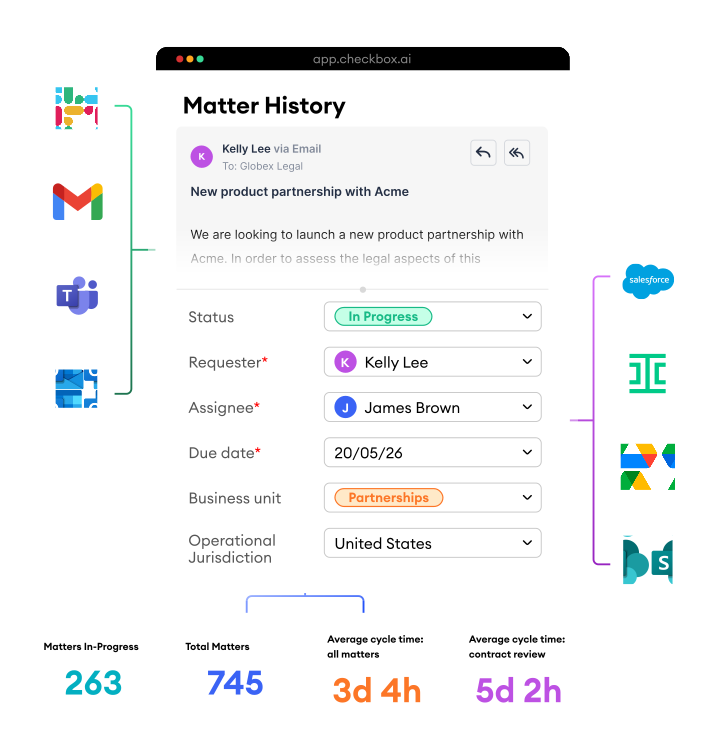
Scoped this way, the first legal operations hire owns three things:
- How work enters the function → The legal intake channels (i.e. Teams, Slack, email, e-forms) and what gets captured at the point of entry.
- How work gets triaged → The logic that determines priority, risk, and routing before a lawyer ever touches the request.
- How work flows downstream → The handoffs from the intake process to the right system or stakeholder, whether that’s a CLM, a matter management system (MMS), a specific lawyer, or a self-service answer.
When legal ops owns this layer, the function changes in ways that show up everywhere else. Legal suddenly has visibility into demand, lawyers stop being the human triage layer, and the downstream tools have a structured pipeline feeding it accurate inputs rather than a mix of a email threads and Slack DMs. And the GC, for the first time, has real data on what the legal function is being asked to do.
Why Scoping a Legal Ops Role Around the CLM Fails
When role of a legal operations professional is scoped around the CLM, three things tend to happen.
1. The Tool Problem
The legal operations hire spends their first six months on an implementation that quietly underperforms because the upstream layer feeding the CLM doesn’t exist. Contracts arrive in inconsistent shapes, from inconsistent channels, with inconsistent context, and the CLM does what it can with what it gets. Adoption stalls somewhere between thirty and forty percent, and nobody can figure out why.
2. The Leverage Problem
The hire spends their political capital on the wrong battles. They’re negotiating with sales over CLM templates when they should be negotiating with the business over how legal gets engaged in the first place. The CLM-first scope keeps them locked inside the contracting workflow when the actual leverage point is one step upstream.
3. The Retention Problem
The structural reason most first legal ops hires churn inside eighteen months isn’t bad cultural fit or poor management. It’s that they were hired to fix a downstream symptom and given no authority over the upstream cause. That kind of role is impossible to win, and good candidates eventually figure that out.
How to Write a Legal Ops Job Description
Once you accept that the role of legal ops belongs upstream, the legal ops job description needs three concrete shifts:
- Reframe the headline responsibility. The first responsibility isn’t “own the CLM” or “drive contracting efficiency.” It’s something closer to “design and operationalize how work enters and moves through the legal function.”
- Reframe the success metrics. Cycle time and CLM adoption are lagging indicators of an upstream system that may or may not exist. Lead with intake structure, request visibility, triage consistency, and routing accuracy. Those metrics tell you whether the function is actually operating, not just whether the tool is being used.
- Reframe the candidate profile. The default profile for a first legal ops hire is a senior paralegal with project management experience and CLM exposure. The better profile is someone with a systems mindset, comfort with cross-functional negotiation, and the patience to design a process before they build a tool on top of it. CLM expertise can come later, or from a second hire.
A JD built around these three shifts looks different from the one most companies write. It also produces a different outcome.
What to Question Before Hiring a Legal Ops Manager
Before the job goes live, the question worth answering is this: “If this hire builds nothing but the way work enters the legal function, will the function be better off?”
If the answer is yes, the role is scoped correctly. The first legal operations hire’s job is to build the foundation, not to optimize the floor above it. CLM cycle time will not improve dramatically in the first six months because the hire’s attention is correctly directed upstream. The visible bottleneck (typically contracting) is not the same as the leverage point (intake), and the only sustainable way to fix the visible one is to fix the upstream one first.
If the answer is no, the role is scoped around tools rather than systems, and the hire is being set up to chase symptoms for as long as they stay.
Most companies don’t have this conversation before they post the JD. However, the ones that do tend to hire better, retain longer, and build legal functions that actually scale.
Key Takeaways
Hiring your first legal ops manager or legal ops specialist is one of the highest-leverage decisions you’ll make as a GC. Scoping the role around contracting feels safe because contracting is the visible bottleneck. Scoping it around intake feels risky because intake is the invisible one. The companies that get this right understand that the safe choice is usually the expensive one, and the risky choice is usually the structural one.
The first hire should own the layer that determines whether everything else in the function can work. So, if you’re scoping your first legal ops role and want to see what a working Legal Front Door looks like before you finalize the JD, book a call with one of our technology consultants today.