

In-house legal ops leaders and GCs are openly comparing per-seat licenses for premium legal AI software such as Harvey and Legora, against general-purpose AI subscriptions with practice-area plugins. They are specifically questioning what additional value justifies the higher price.
With the rise in popularity of vibe coding and practice-area plugins, in-house legal ops leaders and GCs are starting to question:
**“If we can use the legal-specific plugins offered by our current AI subscription to build tools for legal, why should we pay the premium for ‘premium’ legal AI software like Harvey or Legora?”**
This question is coming up more and more frequently during subscription renewal discussions, in legal ops communities, and across industry forums.
What’s changed in recent months is the credibility of the alternative. General-purpose AI providers have entered the legal space with practice-area plugins, built-in integrations for tools lawyers already use, and assistants embedded directly in Microsoft Word. Their capabilities have improved to the point where the build-it-yourself option can no longer be dismissed as a hobbyist exercise.
However, the conversation usually breaks down at the level of analysis. Comparing prices between tools that operate at different layers of the legal stack leads to misleading conclusions about value. Before a GC can decide whether the premium is justified, the spend on both sides needs to be clearly broken down and evaluated, including the parts of the build that don’t show up on the invoice.
The Four Layers of a Legal AI Investment
A legal AI investment is a bundle of four distinct layers that each solve a different problem.
1. The Model
The model refers to general-purpose AI tools like ChatGPT, Claude, or similar. It is the core intelligence that handles tasks like drafting, summarizing, and reasoning. These tools are typically sold by providers on a per-user (per-seat) basis, with some plans including enterprise features like security controls and audit logs.
2. Practice-Area Knowledge
Practice-area knowledge refers to expertise in specific legal fields such as contract law, employment law, intellectual property, and corporate law. It includes the structured prompts, playbooks, and reasoning methods that make a general AI model useful for legal tasks. Today, many general-purpose AI providers package this capability as built-in plugins within their core products.
3. Workflow and Orchestration
The workflow and orchestration layer refers to how legal work gets done from start to finish. This includes intake of requests, triaging and prioritizing them, routing work to the right people, automating multi-step processes, managing matters, and capturing knowledge along the way.
In simple terms, it is the operational layer that takes a request from the business and turns it into a completed, resolved matter. These capabilities are typically not provided out-of-the-box by general-purpose AI tools. Instead, they are built into specialized platforms designed for in-house legal teams.
4. Integration Into Systems of Record and Channels of Work
Integration into systems of record and channels of work refer to processes such as contract management, document management, and ticketing. These capabilities are typically not delivered in depth by general-purpose AI providers. Instead, they require substantial, often complex integration work to function effectively within an organization’s existing tools and workflows.
When you break down a legal AI investment in this way, the framing of the discussion changes. Different AI products operate at different layers of the stack, and the value each delivers is shaped by the layer it operates in. That’s why it’s difficult to compare two products solely on price without first identifying which layer each one owns.
The Four Layers of a Legal AI Investment
Shipped by general-purpose AI
Built and maintained by your team
-
The Model
Core intelligence for drafting, summarizing, and reasoning
Shipped
-
Practice-Area Knowledge
Structured prompts, playbooks, and reasoning for legal tasks
Shipped
-
Workflow and Orchestration
Intake, triage, routing, matter management, knowledge capture
You build
-
Integration Into Systems & Channels
CLM, DMS, ticketing, Slack, Teams, email
You build
Layers 1 and 2 are sometimes bundled into general-purpose AI subscriptions. Layers 3 and 4 are not, and the build cost is what the pricing comparison usually misses.
Hidden Costs of Building Legal Tools Using General-Purpose AI
General-purpose AI providers build horizontally. They ship intelligence and capability across every industry at once, optimized for breadth rather than depth in any single function. They’re not building the operational layer specific to how an in-house legal team actually receives, triages, and routes work, and they’re unlikely to. That layer requires assumptions about how a legal function operates that don’t generalize across industries.
The workflow and orchestration layer has structural requirements general-purpose AI isn’t building toward. It needs:
- A presence in the channels where work actually arrives, so requests get captured before they fragment across email threads and DMs
- An understanding of intake patterns specific to legal, including matter type, risk tier, business unit context, and urgency
- Orchestration that produces structured data as a byproduct of doing the work, not as a separate reporting exercise on top of it
- Institutional knowledge that updates in real time when legal teams correct an AI response, rather than knowledge that lives in static playbooks going stale the day they’re written
- Matter management and cycle time visibility tied to the same legal front door the requests came through
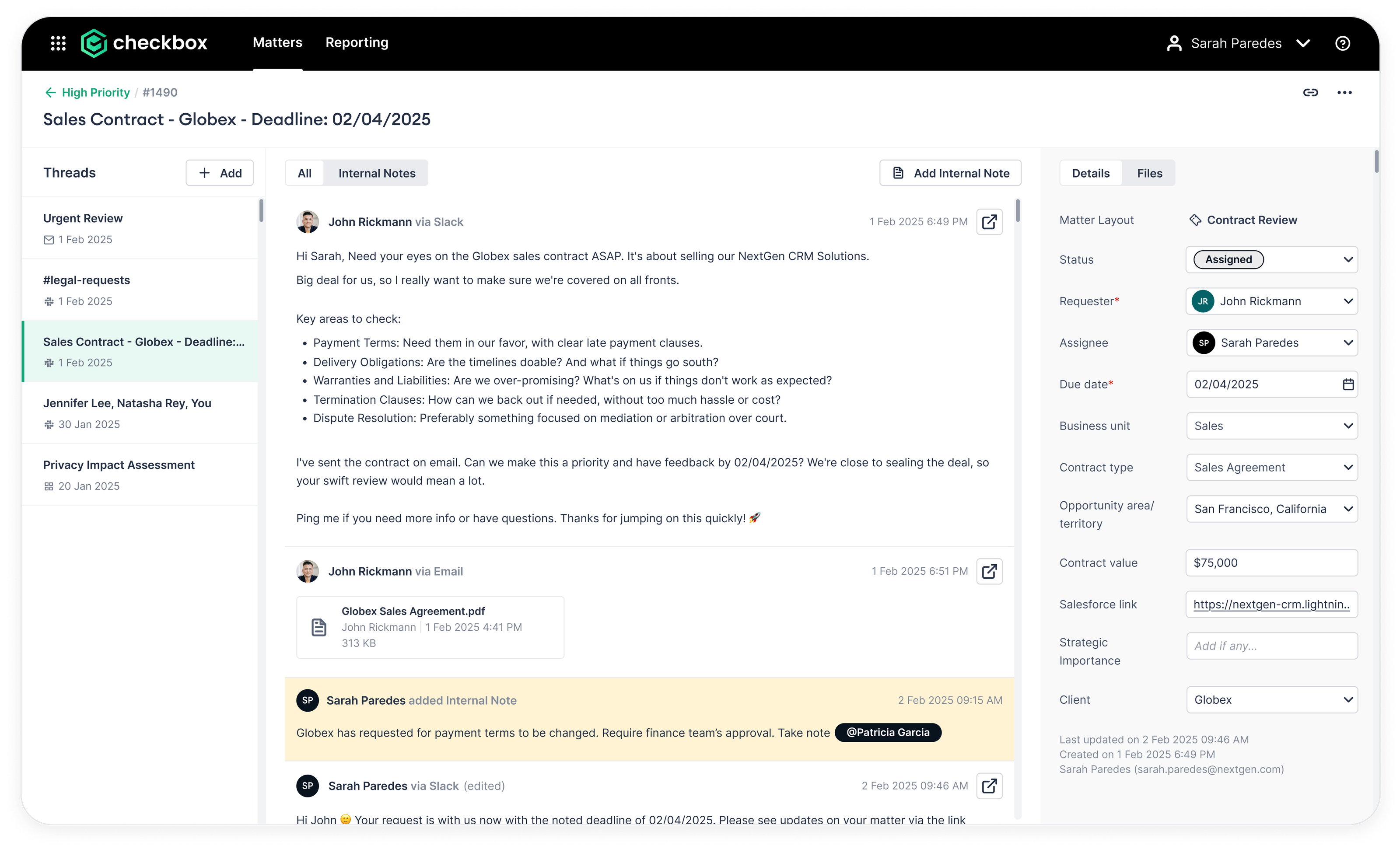
Products operating at this layer are doing different work than products operating at the model layer. A general-purpose AI plugin makes a lawyer faster at what reaches their desk, whereas a workflow and orchestration platform changes what reaches the desk in the first place. Those are different categories of value, and they compound differently. Faster individual tasks save time once. Structural changes to intake and routing free capacity that keeps accruing every quarter. Structured data on demand patterns powers outside counsel decisions, headcount planning, and the case for legal as a strategic function.
How to Evaluate Legal AI Spend in 2026
For GCs evaluating legal AI spend in 2026, four questions help separate signal from noise.
-
Which layer of the stack does this product actually own?
Model, practice-area knowledge, workflow, or integration. Vendors often claim more than they own.
-
If you chose the lower-cost option, what would you have to build?
Intake, routing, integrations, knowledge management, reporting. Build cost and maintenance cost both belong in the comparison.
-
What does this product generate as a byproduct of being used?
Structured data, cycle time visibility, captured knowledge. These compound. Faster individual tasks don’t.
-
What survives if the underlying model changes?
Workflow data, integrations, audit trails, knowledge. Products that are primarily a model wrapper don’t.
Key Takeaways
If your main goal is to help individual lawyers work faster on the tasks they’ve already received, and you have engineering support to build and maintain systems around a general-purpose AI tool, the lower upfront cost will probably be enough to deliver meaningful savings.
However, if you’re constrained by the volume and shape of work reaching legal in the first place, and the function doesn’t have IT capacity or extensive prompt engineering skills to absorb a multi-system build, investing in a purpose-built legal AI automation platform is the more scalable, economical choice.
What’s worth noting is that the legal AI category covers a much wider pricing range than the loudest headlines suggest. Premium legal AI tools like Harvey and Legora sit at the higher end of that range, but they aren’t the only alternative to general-purpose AI. Software that is purpose-built for in-house legal teams, such as Checkbox’s AI Legal Front Door, operates at a different layer of the stack and is priced accordingly.

So, if you can use the legal-specific plugins offered by your current AI subscription to build tools for legal, why should you pay the premium for AI-powered legal-specific software? Because the plugins handle the model and practice-area layers, but the workflow, intake, routing, and integration layers still have to be built and maintained by your team. The premium pays for a different category of value, not a more expensive version of the same one.
Schedule a call with one of our technology consultants to see how this works in practice.