


Some organizations allow employees to use their personal laptops, phones, and tablets to access company systems, review documents, and communicate with customers every day, often across multiple jurisdictions and time zones.
For the business, Bring Your Own Device (BYOD) policies enable flexibility and productivity. But for legal teams, it introduces a growing set of risks that are harder to see, track, and control.
Sensitive company data now lives outside corporate-owned environments. Personal devices blur the line between work and private use. When something goes wrong, whether it’s a lost phone, a data incident, or a regulatory inquiry, legal is often pulled in late, with incomplete information and limited visibility into what actually happened.
And in an era where remote and hybrid work models are the norm, BYOD risk is becoming a recurring operational issue that legal teams are expected to manage alongside privacy, security, and compliance obligations.
The Core Legal Risks Created by BYOD
BYOD shifts risk away from controlled corporate environments and into fragmented, employee-owned devices. That shift creates several legal exposure points that are easy to underestimate until an incident occurs.
1. Data Privacy and Confidentiality
Data privacy and confidentiality risk increase significantly with BYOD. Personal devices often lack the same security controls as corporate hardware, yet they routinely store or access sensitive business, customer, and employee data. A lost phone or compromised laptop can quickly turn into a reportable incident.
2. Regulatory and Compliance
Regulatory and compliance obligations become harder to manage with BYOD. Privacy regimes often require strict controls over how data is accessed, stored, and deleted. When data sits on personal devices across jurisdictions, demonstrating compliance becomes more complex, especially under tight regulatory timelines.
3. E-Discovery and Investigation
E-discovery and investigation challenges multiply with BYOD. Legal teams may need to preserve, collect, or review data from personal devices during litigation, audits, or internal investigations. Without clear processes and consent mechanisms, this can create delays, disputes, and additional legal risk.
4. Employee Privacy and Consent Issues
Employee privacy and consent issues sit at the center of BYOD risk. Legal teams must balance legitimate business oversight with individual privacy rights. Overreach can damage employee trust, while under-enforcement can expose the company to liability.
Individually, these risks are manageable. Taken together, they make BYOD a recurring, operational legal issue.
Why BYOD Policies Alone Don’t Reduce Risk
BYOD policies are often written once, stored in a handbook or intranet, and acknowledged during onboarding. In practice, employees forget the details, interpret them inconsistently, or don’t know when a situation is serious enough to involve legal, IT, or security.
When incidents occur, reporting is informal. An employee might message IT, email their manager, or mention a lost device days later. By the time legal is looped in, key facts are missing, timelines are unclear, and remediation options are limited.
Policies also fail to address the volume and variety of real-world scenarios. Lost phones, shared devices, personal cloud backups, and unauthorized apps all create different risk profiles, yet they’re often handled case by case with no standard assessment. Without defined processes behind the policy, legal teams are forced into reactive decision-making.
Ultimately, legal risk comes from these BYOD policies not being operationalized in a way that supports consistent, timely action.
Making BYOD Risk Manageable Through Clear Processes
If policies define the rules, processes define how those rules are applied when something actually happens.
Managing BYOD risk requires legal teams to clearly spell out what triggers action, who owns the response, and how decisions are made. That starts with defining specific scenarios, such as a lost device, suspected data exposure, or unauthorized access, and mapping out the required steps for each.
Employees need a clear way to disclose issues early, without guessing who to contact or how serious the situation might be. Legal, IT, and security teams need consistent information up front, not bits and pieces scattered across emails and chat threads.
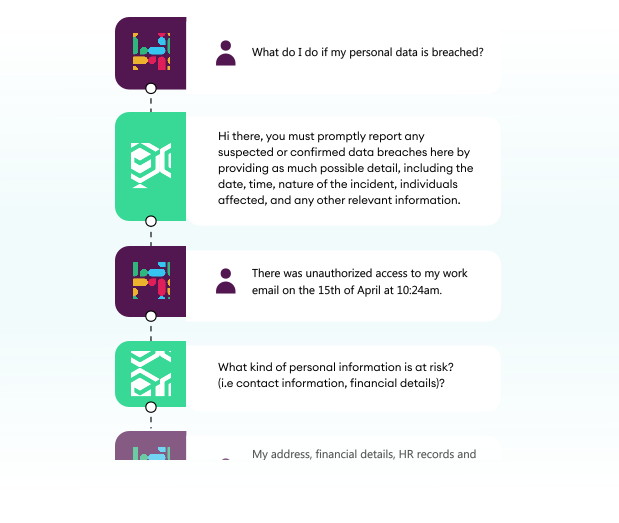
Well-defined processes also remove unnecessary judgment calls. Instead of debating whether an issue “counts” as a legal problem, predefined criteria determine when matters are escalated, documented, or reported.
Ultimately, the goal is faster, more consistent responses that reduce uncertainty, protect employee privacy, and give legal teams confidence that BYOD risks are being handled the same way every time.
Key Takeaways
BYOD is a part of how modern businesses operate, and the risk that comes with it won’t be managed through policy documents alone.
For legal teams, managing BYOD risk means moving from reactive involvement to structured oversight. That requires systems that support consistent intake, clear triage, documented decisions, and ongoing visibility into what’s happening across the organization.
When BYOD is handled through defined processes and supported by automation and reporting, legal teams gain control without slowing the business down. Issues are surfaced earlier, escalations are clearer, and leadership has confidence that risk is being actively managed.
So, in the age of BYOD, legal risk isn’t reduced by writing better rules. It’s reduced by building better ways to apply them.
Want to learn more? Schedule a call with one of our technology consultants today.


