.svg)

Sign up to our newsletter
Get insightful automation articles, view upcoming webinars and stay up-to-date with Checkbox
Reading time:
[reading time]

Google Cloud, LexisNexis, and Harvey have all been in the headlines for new legal AI products in August 2026. But none were built primarily for corporate legal teams. Their launch customers were AmLaw firms, their featured use cases focused on billable work, and their distribution relied on law-firm systems of record. For in-house legal teams, that means many of this year’s most visible legal AI launches are designed around a business model that does not match their own.
That difference is easy to miss when the launch coverage uses the phrase "for legal" without saying which side of the market it means. It also has real consequences for what corporate legal buyers should evaluate, because a product optimized for a law firm's economics rarely delivers the same value inside an in-house team.
Which Legal AI Products Have Been in the Headlines in 2026?
Every legal AI product launch that dominated coverage in August 2026 named law firms as its reference customer. Google Cloud introduced Gemini Enterprise for Legal with Cleary Gottlieb, Freshfields, Weil, and Williams & Connolly as reference firms. Harvey launched an iTimekeep integration to automate law-firm billing workflows, while LexisNexis continued expanding Protégé’s drafting and research tools for firms. Despite serving different use cases, all three products target the same side of the legal market: law firms.
Harvey’s iTimekeep integration, announced on August 17, targets a law-firm-specific workflow. It captures the matter context, time spent, and an AI-generated description of work completed in Harvey, then uses that information to draft a time entry in Aderant’s billing system. This use case does not translate directly to corporate legal departments as law firms bill clients by the hour and in-house teams generally do not. As a result, automating time entry solves a firm-specific problem with no real equivalent for corporate legal teams.
Distinguishing Between Legal AI for Law Firms vs. In-House
The clearest way to tell if a legal AI product was built for law firms or in-house teams is looking at which process the product accelerates. AI tools built for law firms tend to speed up drafting, legal research, citation checking, precedent search, or time capture, because those tasks convert directly into billed revenue. AI tools built for in-house legal teams focus on how requests enter the legal department, how they're triaged, and how they're routed to the right lawyer or automated response.
At a law firm, every hour an associate saves through automation can translate directly into financial value: higher realization, better utilization, or more capacity to handle billable matters at the same rate. That clear connection between time saved and revenue makes law firms a more straightforward market for legal AI vendors, and influences which workflows they prioritize.
Corporate legal teams operate differently. In-house lawyers do not bill by the hour, so their time is primarily an operating cost, not a revenue-generating input. For a general counsel or legal operations leader, the central challenge is not maximizing billable productivity; it is helping the business move quickly while ensuring legal does not become a bottleneck. In other words, the problem is one of organizational throughput, not individual hourly output.
That distinction changes what “AI value” means. At a law firm, a drafting tool that saves 15 minutes per contract is an obvious productivity gain: lawyers can handle and bill more matters.
In a corporate legal team, those same 15 minutes matter only if the request is routed to the right lawyer, includes the necessary context, and is reviewed promptly rather than sitting in an inbox for three days.
Why Don't Law Firm AI Economics Apply to Corporate Legal Teams?
Law firm AI economics don't translate to corporate legal because the two sides of the market make money in opposite ways. Caddi CEO Alejandro Castellano made a version of this point in Artificial Lawyer on August 24. Every legal function runs two economies. The first is the practice of law, meaning the substantive advice that ends up in a document or a call. The second is the business of law, which covers intake, routing, matter opening, status updates, escalations, and reporting. Firms measure the first economy obsessively and barely measure the second. Corporate legal teams don't get to measure either one well, but the second is where most of their time actually goes.
That's the reason downstream AI has been slow to prove ROI inside in-house departments. It compresses a task that wasn't the bottleneck in the first place. A faster drafter doesn't help when the request took eleven days to land on the drafter's desk because it came in through a Teams DM to the wrong person, got misclassified, and had to be re-scoped twice. Most in-house productivity ceilings aren't set by how fast lawyers work. They're set by how work enters the department.
What Should In-House Legal Teams Look For In AI Tools?
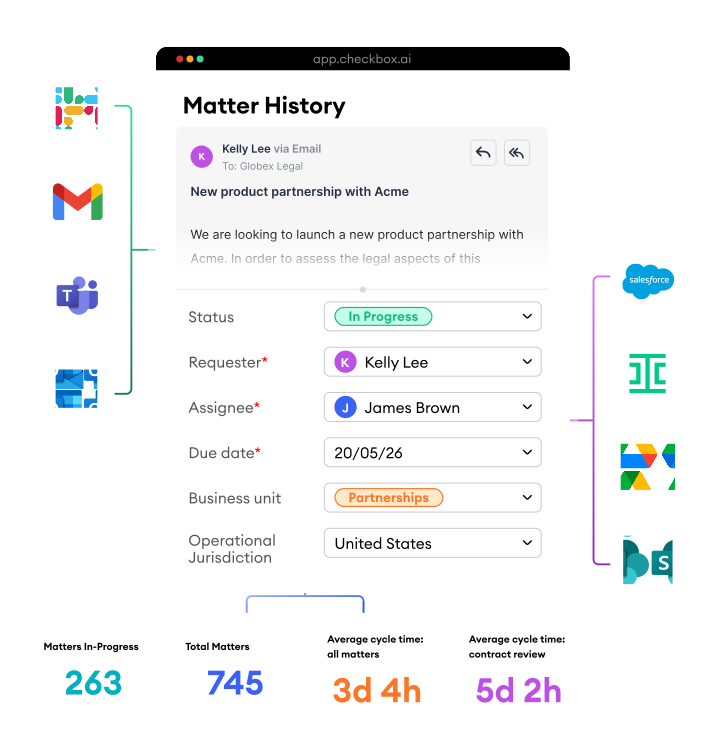
Corporate legal teams evaluating AI in 2026 should focus on the front end of the workflow first. That means how requests enter the legal department, how they're classified, and how they're routed to the right lawyer or automated response. Downstream AI tools perform best when they receive structured, accurately triaged work. If they are added to an already disorganized intake queue, however, their impact will be limited.
Start with the legal request intake process. Where do requests come from today, and how many channels are involved? Which requests genuinely require legal review, and which could be handled through self-service, templates, or automation? Who decides this, and what criteria do they use? Once a request is classified, how is it routed? Finally, how much lawyer time is currently spent triaging work that does not require legal expertise?
The answers to these questions determine whether a downstream AI investment creates lasting value or simply adds speed to a flawed process. A drafting tool attached to a broken queue only produces the wrong work faster. But an effective intake and triage layer such as an AI legal front door ensures the right work reaches the downstream tool, so each upstream improvement increases the value of every step that follows.
Key Takeaways
The legal AI launches dominating headlines in 2026 have been built for the buyer with the clearest revenue case, the biggest budget, and the most valuable reference logos, which is the law firm. That doesn't make them the wrong products for their intended market. It makes them wrong-shaped for corporate legal teams, whose economics reward controlling how work enters the function rather than accelerating what happens once it lands on a lawyer.
For in-house legal teams, investing in legal AI without first improving intake and triage simply automates the existing chaos. The teams moving up the maturity curve are the ones treating the legal front door as infrastructure, not as a feature.
Ready to see what legal AI looks like when it's built for corporate legal rather than adapted from a firm workflow? Schedule a call with one of our technology consultants today.
Frequently Asked Questions
Why do the legal AI launches getting the most coverage tend to target law firms?
Law firms have the clearest revenue case for legal AI, because every hour a lawyer saves through automation converts into higher realization or additional billable capacity. That direct link to firm revenue makes them easier to sell to, easier to reference publicly at launch, and easier for trade press to cover.
Does Google Gemini Enterprise for Legal work for in-house teams?
Google has said the product covers both law firms and corporate legal departments. The launch customers, integration ecosystem, and showcase workflows were designed around law firm buyers, so in-house teams often find they need additional infrastructure underneath before the value shows up.
What's the difference between legal AI for law firms and legal AI for in-house teams?
Legal AI for firms focuses on making billable work faster and capturing time accurately, because that's how firms make money. Legal AI for in-house teams focuses on controlling the volume, routing, and prioritization of work entering the department, because in-house cost pressure comes from throughput rather than billing efficiency.
Where should in-house legal teams start with AI in 2026?
Most in-house teams get the fastest return by structuring the front end of their workflow first, meaning how requests come in, how they're classified, and how they're routed. Downstream AI tools compound value when they're fed structured work and struggle when they're layered onto an unmanaged queue.

Checkbox's team comprises of passionate and creative individuals who prioritize quality work. With a strong focus on learning, we drive impactful innovations in the field of no-code.
Book a Demo
See the New Era of Intake, Ticketing and Reporting in Action.