

It started as a routine vendor agreement.
Standard terms, a familiar counterparty, a legal team that had signed hundreds of contracts just like it. By every measure, it should have been done in a week. Maybe two if stakeholders were slow to respond.
Instead, it took 47 days.
The request came in over email, like most do. The lawyer handling it had to track down the right template, cross-reference it with the latest approved version, and manually pull in the relevant deal details. Then the Word doc was emailed back to the business for review. It returned with comments. It went to external counsel. It came back again. At some point, version control collapsed, and someone was working off the wrong draft. An approver was looped in late. The signature process added another week.
Everyone was doing their job. The process just wasn’t built for speed.
This is a common experience for many in-house legal teams. The delays aren’t caused by underperforming lawyers. They’re caused by workflows that were never properly designed in the first place. Shared inboxes standing in for intake systems. Spreadsheets doubling as contract trackers. Redlining happening in isolation, disconnected from the rest of the lifecycle.
So, the 47-day contract isn’t a talent problem. It’s a systems problem. And the good news is that systems can be redesigned and reworked with modular tools that don’t require months of configuration and change management.
Where the Time Actually Goes
Ask most lawyers where time gets lost in the contract process and they’ll point to review. Back-and-forth redlining, negotiation cycles, and waiting on counterparties create a lot of delays. And yes, that’s part of it. But the truth is, contracts start losing time long before a lawyer opens the document.
It starts at intake. A business user needs a contract and isn’t sure who to reach out to, what information to provide, or what type of agreement they actually need. So, they send an email (or maybe a Slack message) to the legal team. A lawyer receives it, asks a few follow-up questions, waits for answers, and eventually has enough context to get started — except now two or three days have passed and nothing has been drafted yet.
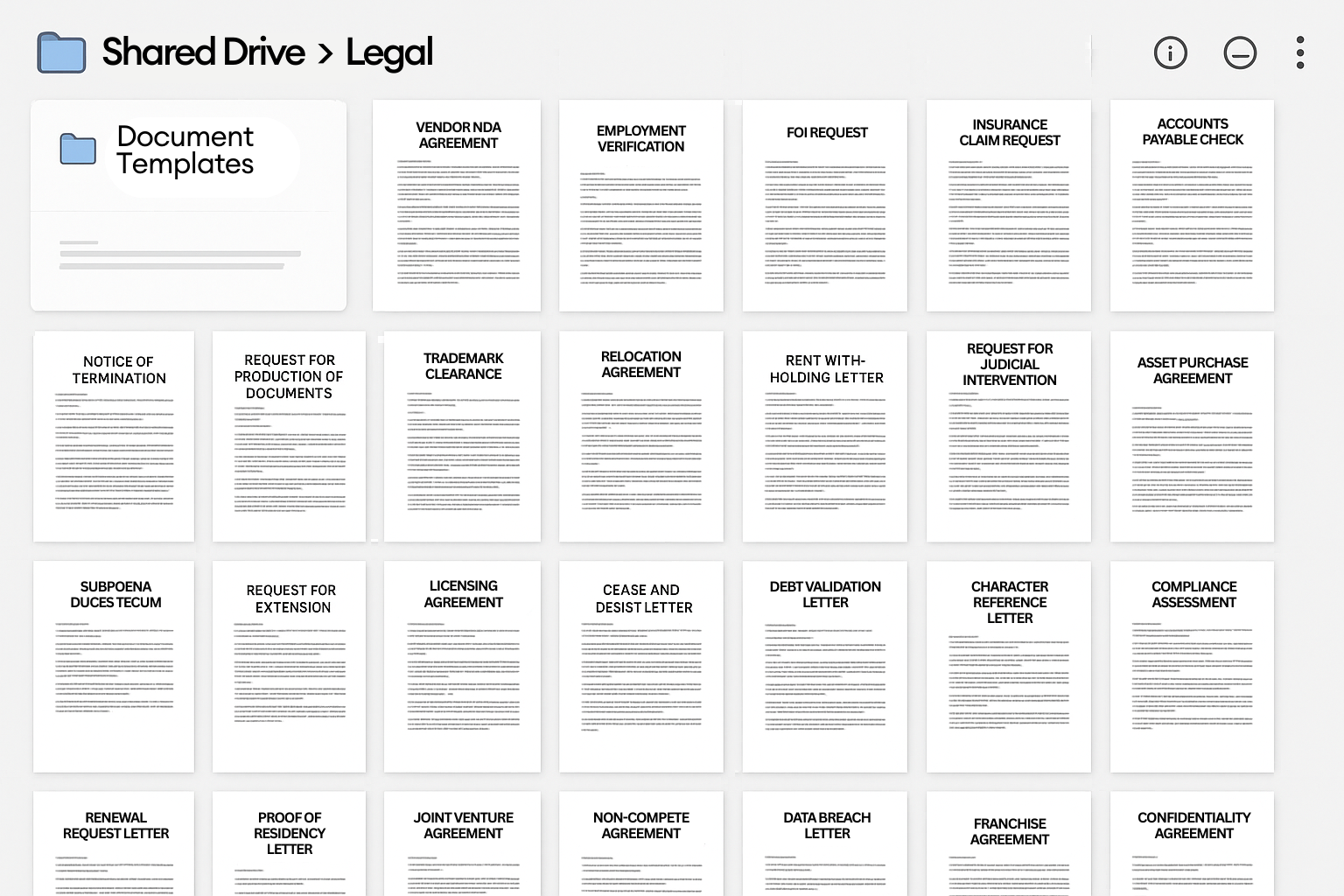
Then comes the template problem. Most legal teams have a library of templates somewhere. Typically, we see them stored in shared drives, email folders, or SharePoint sites that haven’t been properly maintained. Finding the right template, confirming it’s the most current version, and manually populating it with deal-specific details is a process that can eat up hours on its own. And by the time a draft lands in a lawyer’s hands for review, it’s already carrying the weight of a slow start. And the review stage is where things can either accelerate or stall further.
“
Traditional contract review workflows effectively reset to zero every time — even for familiar clauses — so legal spends most of its time repeating the same work instead of applying judgment.
Caitlan Rocha In-House Counsel at Ivo
Ultimately, the bottlenecks are distributed across every handoff in the process, with each one adding a day here and a day there, until a routine agreement has quietly consumed six weeks of calendar time.
Why CLMs Haven’t Fixed This
The obvious response to all of this is: isn’t that what CLM platforms are for?
In theory, yes. Contract Lifecycle Management (CLM) platforms were built to solve exactly these problems by centralizing contracts, automating workflows, and giving legal teams visibility from request to signature. The pitch is compelling, and for many teams, it’s enough to justify a significant investment. But then implementation begins. What gets described in the sales cycle as a few weeks of onboarding routinely turns into months of configuration, IT involvement, and change management.
“
CLMs improved visibility, but not comprehension. They represent a shift to digitization—not a shift away from manual work. CLMs answer ‘where is the contract?’, not ‘what does it say, and what should we do about it?’ They store agreements, but they don’t extract or operationalize the intelligence inside them. Until contracts are understood as data, not documents, legal teams will stay stuck doing manual interpretation.
Caitlan Rocha In-House Counsel at Ivo
The result is a tool that gets used by some people, some of the time, for some parts of the process. The rest still happens in inboxes and spreadsheets — just now alongside a platform that costs six figures a year.
This reveals the structural problem with an all-in-one model. When a single platform has to serve every stakeholder across every stage of the contract lifecycle, something always gets compromised. Usually, it’s the review experience for lawyers, or the simplicity of the interface for business users, or both.
What a Modern Contract Workflow Looks Like
Instead of asking “which platform can handle everything?”, the teams moving fastest are asking a better question: “what does each stage of our contract process actually need?”
Intake needs to be simple enough that any business user can navigate it without training. Review needs to work the way lawyers already work. Approvals and signatures need to move without manual chasing. And everything needs to connect, so nothing falls through the cracks between steps. That’s the thinking behind the modern approach to legal systems: modular legal tech stacks.
Checkbox + Ivo Example
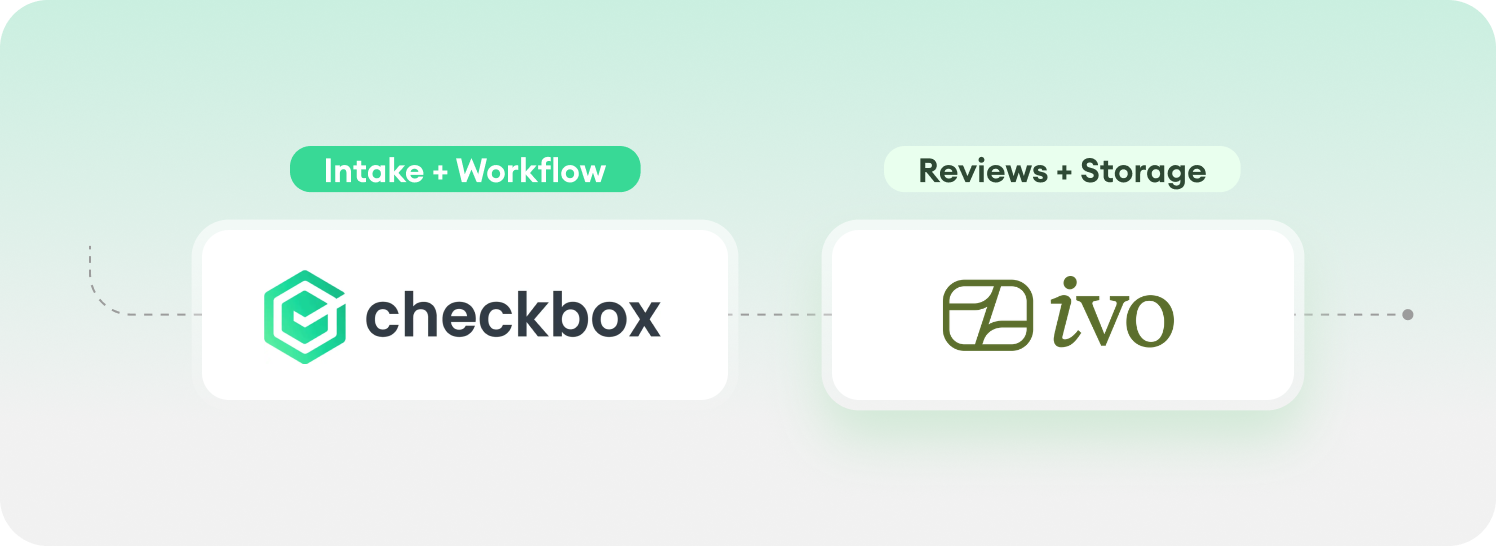
When a contract request comes in (whether through email, Slack, Microsoft Teams, or Salesforce) Checkbox’s AI Agent module guides the requester through providing the right information, then either generates a first-party contract from pre-approved templates or accepts a third-party paper uploaded by the business. From there, the contract is automatically routed to the appropriate stakeholders based on factors like contract type, value, or risk level, and notifications are triggered when action is required, keeping requesters updated on status throughout the process.
When it’s time for legal review, Checkbox provides the contract in a .docx format so lawyers can open it directly in Microsoft Word and leverage Ivo for AI-powered review and redlining. Ivo surfaces risks, flags inconsistencies, and accelerates the redlining process, without pulling lawyers out of their existing environment or forcing them to learn a new interface.
Once edits are complete, the updated version is re-uploaded into Checkbox to continue through approvals or signature. And when the contract is fully executed, it’s automatically saved to the team’s document storage system (i.e. SharePoint, Google Drive, or otherwise) syncing seamlessly with Ivo’s repository for advanced search, composite views of document edits, and post-execution insights.
Every stage is connected ensuring no version confusion or chasing signatures over email. This offers two best-in-breed tools that work together as one cohesive workflow.
Why a Modular Approach Beats an All-in-One CLM
For years, the assumption in legal tech has been that consolidation equals efficiency — that the right move is to find one platform capable of managing the entire contract lifecycle and commit to it fully. Fewer tools mean fewer integrations, fewer vendors, fewer logins. Simpler (in theory).
But in practice, the all-in-one bet comes with a hidden cost: compromise. Every hour spent configuring a platform that doesn’t quite fit, every lawyer who works around the review interface instead of through it, every business user who defaults back to email because the intake process is too cumbersome — these are the compounding costs of choosing breadth over depth.
“
When I talk about CLM, I think about intake, review, and repository. With Checkbox and Ivo, I have a CLM system that I’ve built myself using different tools with best-in-breed functionality, instead of having to give up some things because the CLM platform, which is a holistic tool, doesn’t have what I need.
Jen Lenander Sr. Director & Legal Chief of Staff at Elastic
A modular CLM approach recognizes that the contract lifecycle has distinct stages, each with distinct requirements, and that the best tool for intake is probably not the best tool for AI-powered redlining. Just as sales teams long ago stopped expecting their CRM to also be their outreach tool and their forecasting platform, legal teams are starting to build stacks that reflect how the work actually gets done.
And when the right platforms are integrated properly, the experience is seamless. Data flows between stages, nothing gets lost at the handoffs, and legal has full visibility from the moment a request is submitted to the moment a contract is stored in the repository.
The shift isn’t about adding more tools. It’s about choosing the right ones and connecting them well.
It Was Never Your Lawyers
To be fair, some deals are genuinely complex, some counterparties are difficult, and some negotiations take time because they should. But for the vast majority of routine agreements such as NDAs, vendor contracts, and renewals that legal teams sign dozens of times a year, the delay rarely comes down to the substance of the deal. It comes down to everything around it such as:
-
The time spent tracking down the right template,
-
The approval that sat in someone’s inbox over a long weekend,
-
The version that got lost when two people were editing simultaneously, or
-
The signature that needed three reminder emails.
None of that has anything to do with the quality of the lawyers involved or the complexity of the terms being negotiated. Its just friction built into a process that was never properly designed in the first place.
That’s the point. The 47-day contract is likely a process problem, not a people problem. And process problems are fixable.
The teams that have made the shift away from hoping a single platform will eventually work as promised and toward connecting purpose-built tools that each do their job exceptionally well, aren’t just saving time on individual contracts. They’re changing what it feels like to work in legal. Lawyers spend less time on coordination and more time on the work that actually requires their expertise. Business users get visibility without having to chase anyone. Leadership gets the reporting and oversight they’ve always wanted but never had.
So, if your contract process still feels slower than it should, the answer probably isn’t to work harder or hire more people. It’s to look honestly at where the time actually goes and build a workflow that doesn’t lose it in the first place.
Ready to see what that looks like for your team? Schedule a call with one of our technology consultants to walk through how modular tools like Checkbox and Ivo work together and what a modern contract workflow could look like for your organization.