

Most legal teams now have an AI policy, but far fewer have defined AI standards. A policy defines which tools are approved and what data must stay internal. Standards, on the other hand, specify which types of legal work AI can handle, the required level of review, and who is responsible for final sign-off.
Axiom’s 2026 In-House Legal AI Report surveyed 528 in-house leaders and found that only 7% of legal teams have successfully integrated AI into their operations, while 83% are unable to demonstrate a return on investment. That gap comes from a lack of clear decisions on how to use such technology. When no one defines where machine output stops and lawyer judgment begins, that line gets set by default, often by whoever happens to be busiest at the time.
This article outlines a standards framework you can implement within a quarter: categorize work by the level of judgment it requires, assign appropriate reviewers, require clear disclosures, and embed these practices directly into your workflows instead of relying on a written memo.
Why Legal Teams Need Written AI Standards
Legal teams need clear, written AI standards because the way people are using AI is advancing faster than the rules that govern it. A July 2026 Progress Software report found that 85% of lawyers now use AI in some form, even while manual work still dominates their workflows. When adoption reaches that scale without clear limits, AI gradually shifts from a drafting assistant to an unofficial decision-maker.
Picture a lawyer on a tight deadline who asks an AI to summarize a negotiation position, then to suggest which one to choose. Or a business team that pastes contract language into a chatbot because legal is overloaded. Each of these actions feels routine. But taken together, they gradually and quietly shift where the real decision-making line sits.
How to Classify Legal Work by Judgment Intensity
Sort your team’s work into three tiers based on how much judgment it demands, then decide what role AI plays in each. This tiered approach does most of the work in an AI standard, replacing countless one-off decisions with a single clear, intentional framework.
- Routine and repetitive legal work: Use standard NDAs based on your templates, handle recurring policy questions consistently, and prepare first drafts of routine matters. AI can assist by drafting, summarizing, and sometimes responding directly via an AI chatbot, with periodic spot-check reviews instead of reviewing every item line by line.
- Judgment-heavy legal work: This includes negotiated terms, employment issues, and regulatory interpretation—areas where outcomes depend on context and have real consequences. AI supports research and drafting, but every output is reviewed by a qualified lawyer before it is finalized.
- High-stakes legal matters: In areas such as litigation strategy, M&A, board advisory, and government investigations, AI plays a limited, supporting role. It is used primarily for tasks like organizing documents and verifying citations. Any AI-generated analysis is reviewed by senior professionals before it is shared with decision-makers.

Many teams make the mistake of applying the wrong level of control. They put too many restrictions on tier one, where mistakes are low-risk and quickly corrected, and too few on tier two, where tasks seem routine but carry meaningful risk. If you only rigorously check one boundary, focus on the transition between tier one and tier two.
Who Reviews AI-Assisted Work and How Should AI Use Be Disclosed?
Every tier should have a clearly named reviewer, and every AI-assisted legal work product must be labeled as such. Saying “legal reviews it” diffuses responsibility, and standards only work when a specific role (ideally a specific person) owns the sign-off for each tier and understands they are accountable.
Disclosure should work the same way. Requiring lawyers to label AI-assisted work, at least for internal use, supports more accurate review and creates a useful record. If something goes wrong, you can identify which outputs involved AI. Over time, this also shows where AI is actually being used, rather than where policy assumed it would be, helping you refine your usage tiers.
Why AI Standards Belong in Workflows
Standards built into workflows are followed, whereas standards buried in memos are often forgotten within weeks.
A memo asks a busy lawyer to remember a classification rule and choose to add an extra review step. A workflow, by contrast, makes that review step unavoidable. Any AI standard that relies on memory and goodwill will fail as soon as time pressure hits.
As soon as a legal request enters your legal intake and triage process, it should be classified, because that is when routing decisions are made. Routine requests can go to self-service or automated resolution, judgment-heavy requests go to a named lawyer with the review step already attached, and sensitive matters escalate straight to senior counsel.
This is the foundational entry point that makes standards enforceable. A legal front door captures requests from Slack, Teams, or email, uses AI to triage and classify them before creating a matter, and routes each request through governed workflows with built-in human review. The AI handles what it is permitted to answer, while more complex or judgment-based requests are escalated to the appropriate reviewer. All actions are recorded, including what the AI did and who approved each step.
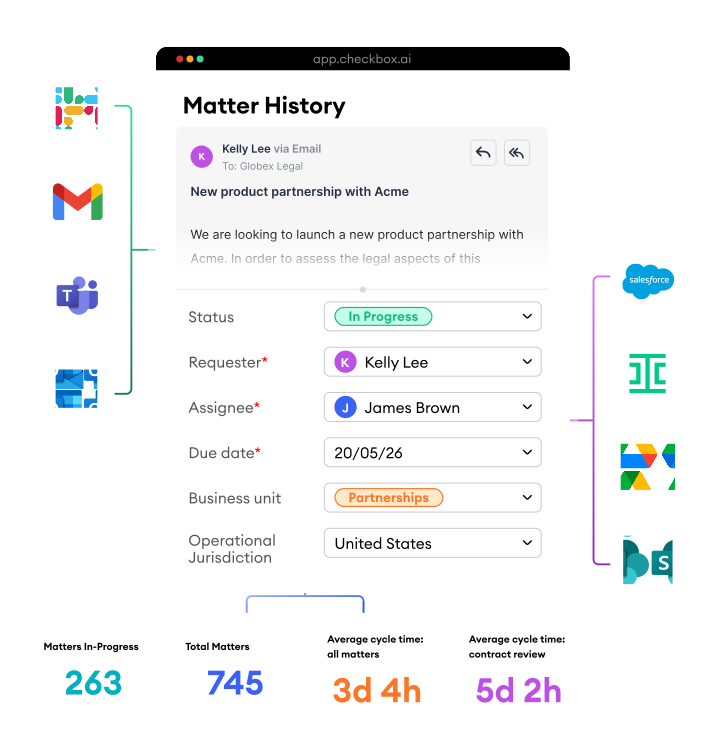
Teams that want tiers enforced rather than remembered typically encode them in legal workflow automation software, so the standard fires on every request instead of only the ones somebody remembers to check.
How Often Should You Revisit Your AI Tiers?
Hold a quarterly review with the same people responsible for each tier. AI models evolve quickly, so a tier map from a year ago may no longer reflect current tools. As AI adoption in legal operations continues to grow, work should be deliberately reassigned between tiers as needed, rather than shifting informally over time.
Bring data to the review such as request volumes by tier, the frequency of corrections needed for sampled tier-one work, and how often tier-two reviewers made material changes to AI-generated output. If reviewers approve about 98% of outputs in a category, it likely performs well enough to be downgraded to a lower review tier.
Key Takeaways
An AI policy names approved tools, while an AI standard goes further by deciding which work AI touches, at what review level, and with whose sign-off.
The most durable way to draw that line is to classify legal work into three tiers by judgment intensity, watching the boundary between routine and judgment-heavy work most closely, then name an accountable reviewer for each tier and require disclosure of AI assistance in work product.
From there, build the standard into intake, triage, and workflow routing rather than a memo, because standards in memos fade while standards in workflows fire on every request. Revisit your tiers quarterly with real correction and usage data, and move work between tiers deliberately instead of letting the line drift on its own.
If you’re looking to enforce your AI standards in your legal workflow, book a demo to see how governed intake, escalation routing, and human review steps work in Checkbox.