


“Legal AI” has become one of those terms that manages to mean everything and nothing at the same time. Ask five vendors what their product does and you will get five variations of the same answer: “it is AI-powered, intelligent, and automated”. What they are less forthcoming about is that those five tools are built for entirely different jobs and buying the wrong one is roughly as useful as hiring a surgeon to fix your plumbing.
The legal AI market is, in short, a mess to navigate because the marketing has gotten well ahead of the taxonomy. Every tool is AI, every demo is impressive, and for in-house legal teams already stretched thin, the pressure to buy something can make it genuinely hard to work out what you actually need.
On the surface, legal AI is simple: software that uses artificial intelligence to help lawyers and legal teams work faster and more effectively. But that description covers an enormous amount of ground, from tools that draft contracts to tools that mine case law to tools that manage the flood of requests arriving from the business every day. These are distinct categories, built for distinct jobs, at distinct points in the legal workflow. And once you can see those distinctions clearly, the market stops feeling overwhelming and starts feeling manageable.
So, let’s break them down: what the four main categories of legal AI actually are, what each one is built to do, and how to tell them apart.
What Are The Different Types of Legal AI?
Legal AI broadly splits by two things: what kind of work it performs, and where in the process it operates. Understanding both dimensions is what makes it possible to compare tools honestly.
| Type of Legal AI | Primary job | Where in the workflow |
|---|---|---|
| Intake & Triage AI | Route, qualify & gather before work begins | Upstream, pre-workflow |
| Document Generation AI | Draft, redline & produce legal content | Early-to-mid workflow |
| Contract & Document Intelligence AI | Review, extract & analyze existing documents | Mid-to-late workflow |
| Legal Research AI | Search, synthesize & surface legal insights | Mid workflow |
Note: Intake and triage AI sits at the top because it is the layer everything downstream depends on.
1. Intake and Triage AI
Intake and triage AI sits at the very top of the legal workflow, managing the point at which requests enter the function: qualifying what is actually being asked, gathering structured information from the requestor, routing the matter to the right person or resource, and handling routine queries without a lawyer needing to get involved at all.
Most legal teams underestimate this category because the problem it solves is less visible than slow contract review or time-consuming research. But the volume of requests landing in a shared inbox — unstructured, inconsistently described, requiring follow-up just to understand — is where enormous amounts of legal capacity quietly disappears.
The strongest tools in this category, namely the AI Legal Front Door, automate the full lifecycle of a legal request. This looks like dynamic intake that adapts based on what the business user is asking, conditional logic that routes matters correctly the first time, approval workflows, matter tracking, and AI-guided self-service for queries that do not need a lawyer at all. The output is a structured, actionable matter with everything the lawyer needs to act.
It is important to note that intake and triage AI is not where you go for deep legal reasoning on complex matters. Its job is making sure the right work reaches the right person with the right information, fast. For most legal teams, that is the highest-value problem to solve first.

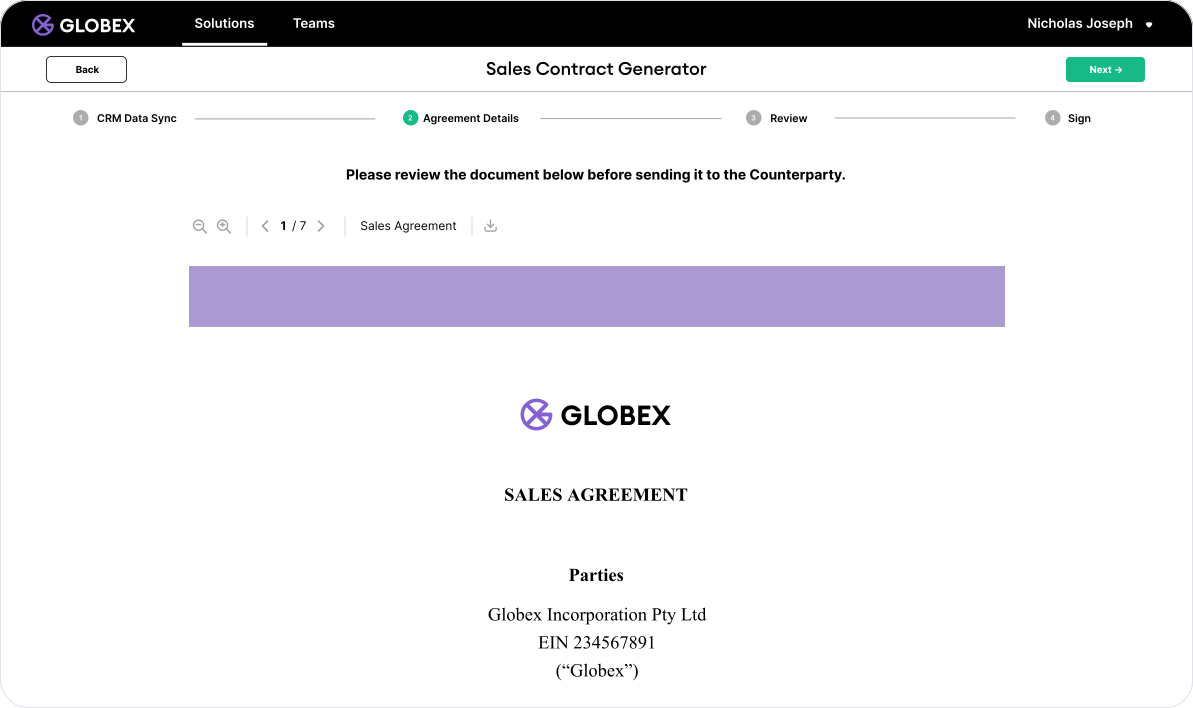
2. Document Generation AI
Document generation AI produces legal content. That means drafting agreements from templates or precedents, generating summaries and correspondence, and producing or redlining clauses benchmarked against how similar positions have been negotiated in the past.
The best tools in this category apply negotiation history, suggest clause language consistent with how the organization has agreed before, and flag where a draft deviates from standard positions. The combination of drafting speed and institutional knowledge is what separates useful document generation AI from a general-purpose language model that will produce a plausible-sounding agreement with no grounding in your organization’s actual positions.
The key differentiator to probe in any evaluation: is the tool generating content in a vacuum, or is it grounded in your organization’s own precedents and playbooks? The latter is substantially more valuable.
While document generation AI produces content, it does not manage the process around that content (i.e. Who requested the document? Has it been approved? Where does it sit in the matter lifecycle?). Those are workflow and operational questions. The drafting and the process surrounding it are two separate problems, and vendors do not always make that distinction clear.
3. Contract and Document Intelligence AI
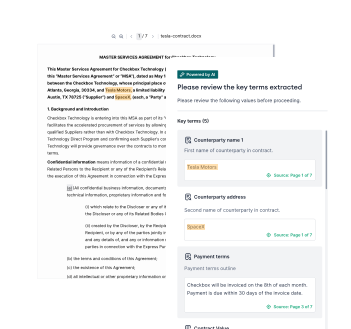
Contract and document intelligence AI processes existing documents at scale. It reviews and analyzes contracts, extracts structured data (e.g. terms, obligations, key dates, counterparties) supports due diligence workflows for M&A or compliance, and surfaces negotiation insights from historical deal data.
This is the category where legal AI has perhaps the longest track record, and where the market is most mature. The use cases are well-understood: reviewing hundreds of contracts against a due diligence checklist, auditing a contract portfolio for renewal risk or non-standard obligations, or preparing for a negotiation using data on how similar deals have been structured.
The distinction from document generation AI is important, and vendors sometimes blur it deliberately. Generation AI creates new documents. Intelligence AI interrogates existing ones. They complement each other, but they are not the same tool, and evaluating them on the same criteria will lead to bad decisions.
Contract intelligence tools are document-focused by design, and they work best when documents are landing in an organized, structured way. They do not touch the operational layer (i.e. how requests are managed, how matters are tracked, how the business gets a response). The process around the documents matters as much as the documents themselves, and intelligence AI addresses only part of that equation.
4. Legal Research AI
Legal research AI searches, reads and synthesizes legal information (e.g. case law, statutes, and regulations) and can typically surface insights from a company’s own prior agreements to flag deviations or risks against the external legal landscape.
What separates the best tools in this category from general-purpose AI is citation grounding. Retrieval-Augmented Generation — where the AI retrieves relevant source material first, then synthesizes an answer grounded in those sources — is the mechanism that gives legal research AI its credibility. An AI that can hallucinate a plausible-sounding case name is a liability, whereas one that surfaces the actual case and provides links to it boosts productivity.
An emerging capability worth watching out for is the application of research-style analysis to internal company data. For instance, surfacing how the organization has handled a specific clause type across its last fifty enterprise agreements. This starts to overlap with contract intelligence, and vendors will increasingly claim both.
Legal research AI makes individual lawyers faster, but it rarely makes the legal function operate better as a whole. It does not reduce the volume of requests hitting your team, streamline approvals, or surface process inefficiencies. It is a productivity tool, not an operational one.

How to Tell Different Types of Legal AI Apart
During a software demo, a polished interface, compelling use cases, and the time pressure of the sales process makes it easy to reach a decision before you have fully understood what you are buying. These four questions cut through that.
-
01
What is the input? A business request? A prompt? An existing document? A legal question? The input tells you almost everything about where in the workflow this tool is designed to sit — and whether that matches where your problem actually lives.
-
02
What is the output? A routed, tracked matter? A drafted agreement? Extracted clause data? A cited legal answer? If the vendor cannot answer this cleanly and specifically, that is itself a signal worth noting.
-
03
Where does it sit in my workflow? Before a lawyer touches the matter? Alongside them while they work? After the fact, for portfolio analysis? A tool placed in the wrong part of your workflow will underperform regardless of how good the underlying technology is.
-
04
Does it solve the whole problem, or just part of it? Every tool in this landscape solves part of the workflow very well. The question is whether the part it solves is the part you most urgently need to fix — or whether it is just the part that makes the best demo.
Legal teams often invest in tools that make lawyers faster at individual tasks, while the operational layer covering how work enters, gets tracked, and gets resolved, remains manual and invisible. Speed at the task level does not fix chaos at the operational level.
Where Should a Legal Team Start With AI?
The most reliable path to a good legal AI decision is to start with your most pressing pain point. Every category in this landscape is useful — but useful in a specific context, for a specific problem.
| If your team says… | Start with… |
|---|---|
| “We’re drowning in ad hoc requests from the business.” | Intake & triage AI |
| “Drafting is eating too much of our lawyers’ time.” | Document generation AI |
| “We can’t get through redlines fast enough.” | Contract & document intelligence AI |
| “Research is a bottleneck for our team.” | Legal research AI |
If the answer is all of the above or “we want AI across everything,” start with the operational foundation first. Point solutions for contract review, research, and drafting layer on top more effectively once the way work enters and flows through the legal function is structured. Without that legal intake and triage foundation, you are optimizing individual tasks inside a chaotic process.
Key Takeaways
Legal AI is divided into four distinct categories:
- Intake and Triage AI
- Document Generation AI
- Contract and Document Intelligence AI
- Legal Research AI
Each is built for a different job at a different point in the workflow. And the teams getting the most from AI are not necessarily using the most powerful tools. Instead, they are focused on using the right tool for the right job, in the right sequence.
The smartest in-house legal functions are starting to think about AI as a stack, not a single purchase: operational infrastructure first, and specialist tools layered on top.
Book a demo today to see how legal teams are using intake and triage AI to build the operational foundation that makes every other AI investment perform better.


