


As artificial intelligence (AI) is now part of the core infrastructure for legal operations, many legal teams are shifting their focus from whether AI belongs in legal, to determining how it should be applied to materially improve the way legal work is managed.
Rather than adding headcount or patching together more tools, many legal teams are rebuilding the foundations of legal work itself. Three capabilities are emerging as essential:
- AI-powered self-service,
- AI-powered triage, and
- AI-driven reporting.
Together, they address the most persistent operational problems in legal including volume, prioritization, and visibility.
Individually, each capability reduces friction. But collectively, they form something more consequential: a single, intelligent entry point for legal work. This model, often described as the AI Legal Front Door, is becoming the default for legal teams that need to scale impact without scaling complexity.
Today, we’ll explore each of the foundational pillars and why they are quickly becoming the baseline for modern AI-powered legal operations.
1. AI-Powered Self-Service
Self-service is not about pushing legal work onto the business. It’s about removing friction from the requests that never needed a lawyer in the first place. Across most organizations, a significant portion of inbound legal demand is repeatable, low-risk, and governed by existing policies such as NDAs, standard approvals, and common compliance questions.
AI-powered legal self-service software makes it possible to handle this work upstream. Instead of sending an email or opening a ticket, business users are guided through structured, policy-aware experiences that surface answers, generate documents, or complete approvals automatically. Guardrails are built in, ensuring that anything outside predefined risk thresholds is escalated appropriately.
The impact is immediate as legal teams instantly see fewer routine requests, faster turnaround times, and more consistent outcomes. The business gets answers without waiting and lawyers regain time to focus on work that actually requires legal judgment.

2. AI-Powered Triage
Once self-service removes the routine work, what remains still needs to be handled intelligently. This is where triage becomes critical and where many legal teams quietly lose the most time.
Without AI, legal request triage is typically manual and inconsistent. Requests arrive through multiple channels and senior lawyers end up wasting time on sorting, forwarding, and clarifying instead of advising. Additionally, decision-making varies depending on who reads the request first.
AI-powered legal intake and triage software changes that dynamic by ensuring requests are automatically understood in natural language, classified by type, risk, and priority, and routed to the appropriate workflow or owner instantly. This means low-risk legal matters move quickly and high-risk issues are escalated early, with the right context attached.
So, when powered by AI, triage becomes a repeatable, consistent decision-making layer of legal operations. It allows legal teams to stop acting as traffic controllers and start operating with intent.

3. AI-Driven Reporting
Reporting has traditionally been legal’s weakest link because many teams face difficulties when trying to capture intake and matter data. When requests live in spreadsheets and decisions happen over disconnected channels such as Microsoft Teams and email, visibility is lost by default.
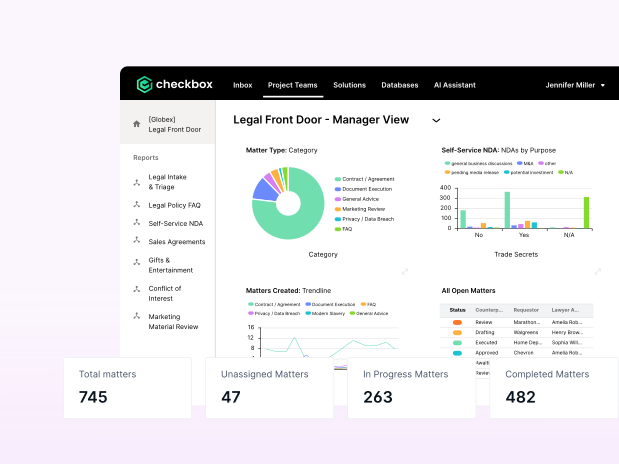
AI-powered legal analytics and dashboard software changes this by making reporting a byproduct of doing the work. As requests flow through intake, triage, and resolution, data is captured automatically. Volume, turnaround time, risk profiles, and workload distribution become visible in real time, without manual tracking or post-execution analysis.
This visibility shifts legal from reactive to operational as leaders always can see where demand is coming from, where bottlenecks form, and how resources are being used. Conversations with the business also move from anecdotes to evidence.
The AI Legal Front Door
Individually, self-service, triage, and reporting solve specific problems. But together, they change how legal work enters and moves through the organization.
The AI Legal Front Door is the unifying layer that brings these pillars together. It provides a single entry point for all legal requests (regardless of type or source) and ensures each is captured, intelligently routed, and tracked from start to finish, with visibility built in by default.
This supports a structural shift that removes the need for lawyers to rely on inboxes, ad hoc judgment calls, or retrospective reporting. Work becomes standardized at the point of entry, decisions are applied consistently, and insight is generated as a natural outcome of execution.
AI legal front door software like Checkbox are built around this model, combining AI-powered self-service, triage, and reporting into a single system of record for legal work. This results in much faster turnaround, clearer visibility, and a legal function that can scale without the added friction of increasing headcount or siloed tools.
Key Takeaways
AI’s impact on legal is defined by structure. Self-service, triage, and reporting are now foundational capabilities for any legal team operating at scale.
Together, they replace inbox-driven work with a system of record. They reduce noise without sacrificing control and they give legal leaders what they’ve long lacked: the ability to manage demand, apply judgment consistently, and show the business how legal work actually moves.
For modern legal teams, the question is no longer whether to adopt these foundations. It’s how long the old model can hold before it quietly gives way.


