

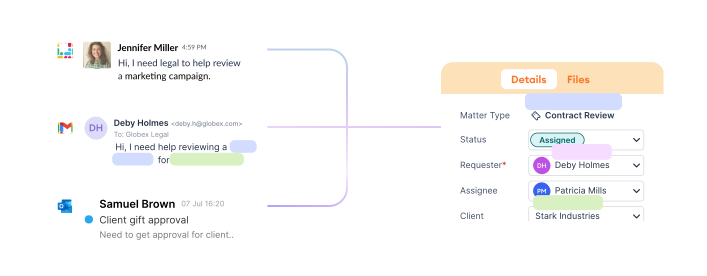
A legal front door (LFD) is a structured intake software layer that sits between the business and legal, collecting requests from multiple channels, funneling them into one stream, and routing them to the right lawyer, stakeholder, or legal self-service process. It’s like a reception desk for legal requests. Even if people enter the building through different doors, they all end up at the reception desk. The receptionist then directs each request to the right team or room, so the legal team receives clear, organized work and can focus on the right priorities.
Most objections to a legal front door for in-house legal teams usually focus on budget constraints, rollout timing, and resistance to change. That means gaining support and buy-in is less about selling the functionality of the technology itself and more about how you present and position it.
So, in this guide, we’ll cover five common objections to a legal front door and show you how to address each one.
1. “We don’t have budget for a legal front door”
The budget objection assumes the front door is an extra cost. But in reality, it should be compared to the intake process you are already paying for. Senior lawyers lose hours each week interpreting unclear requests, tracking down missing context, redirecting work sent to the wrong place, and re-answering the same questions. If you calculate the fully loaded cost of that time, the department is already paying for intake. It just shows up in payroll rather than as software.
When presenting your case to the CLO, emphasize that the department will incur legal intake costs regardless. The issue is not whether money is spent, but how. Under the current approach, intake is handled in the most expensive way possible: counsel time. Even a rough calculation for your team will show that the hidden cost of this inefficiency is often far greater than the cost of a legal front door.
2. “We already have a ticketing system for legal”
A shared inbox or a Jira queue can capture requests. However, capturing requests is the easy part. The more difficult challenges to tackle come afterward: figuring out what each request actually requires, routing it to the right person, handling routine issues without involving a lawyer, and capturing meaningful data about demand. A ticket queue doesn’t solve these problems. It just centralizes requests and still leaves a lawyer to sort through them manually.
For GCs, the key distinction is between a container and a process. Effective legal intake and triage should classify each request, gather the necessary context upfront, route it based on type, urgency, and capacity, and divert routine work into governed self-service. If your current intake process already handles this, your lawyers shouldn’t be spending their mornings manually answering FAQs or sorting through initial enquiries.
3. “We need to finish the CLM rollout first”
Sequencing objections often arise because people don’t realize that the order in which legal tools and processes are implemented actually matters. Legal technology only delivers reliable results when a legal front door is in place first. Every downstream system such as CLMs, matter management dashboards, and reporting tools depend on structured information about what work exists and how it arrived. Teams that implement a CLM before an LFD spend the next year compensating for the gap, manually feeding the system because requests still arrive as unstructured emails that someone has to interpret and convert by hand.
The legal front door sits upstream of everything else, which is why it belongs first on the roadmap. Requests enter structured, routing happens automatically, and downstream systems inherit clean, reliable data. Deferring intake quietly starves the very projects it’s meant to protect. If the department can only fund one thing this year, fund the layer every other investment depends on.
4. “The team is too busy to implement anything right now”
Waiting for a “calm quarter” to fix legal intake is like waiting for the rain to stop before repairing a leaking roof. The calm period never comes, because the workload problem is built into how things operate.
So, the practical answer to such an objection is about implementation shape. A legal front door doesn’t require lawyers to learn a new system from day one. Most of the effort is in the initial configuration, while the user-facing experience is delivered through tools like Slack, Teams, email, and other platforms people already use. Take Checkbox’s AI Legal Front Door, for example. Requests flow in through existing channels, AI-powered legal intake and triage classifies and routes them, and routine questions resolve through self-service before a lawyer is interrupted.
5. “The business will never use it”
Adoption fails because of friction, which makes it a design problem, not a gamble. If a tool is harder to use than the alternative, people will avoid it. For example, a portal that requires logging in will lose to simply emailing a lawyer, because email is faster and more familiar.
Tools that live inside the channels people already use have a clear advantage for the same reason. Essentially, the approved path needs to be the easiest path. When it is, people will naturally choose it without needing to be told.

Additionally, there’s an important second-order benefit to highlight for your CLO. When all requests come through a single front door, they leave a record, making legal’s workload fully visible. This means, the business gets faster responses, and legal gains concrete data to support headcount and budget requests.
How to Turn Five Answers Into One Business Case
Objection handling may win the argument, but a strong business case wins the budget. Present your proposal in three parts.
First, quantify the current cost. Run a one-week interruption audit and project it across the year using fully loaded hourly rates.
Second, make a direct comparison. Place that annual cost alongside the cost of implementing a front door, and clearly show the difference.
Third, propose a minimal, credible starting point. One team, three request types, over ninety days, with success defined upfront by deflection rate and turnaround time.
Framed this way, your proposal gives a CLO something concrete to approve rather than something abstract to believe in. It also turns “not this quarter” into a decision with a specific future date.
Key Takeaways
Every objection to a legal front door has a practical answer. The department already pays for legal intake in counsel time, a ticketing queue centralizes requests without triaging them, downstream systems like CLM depend on structured intake data to work as promised, the busiest teams have the most to gain from fixing intake first, and adoption follows whichever path is easiest by design.
Answer each objection with your own numbers, then package them into a three-part business case: the current cost, the direct comparison, and a minimal ninety-day starting point with success defined upfront.
Want to learn more? Book a demo to see how Checkbox’s AI legal front door gives the business a reception desk for legal requests it will actually use.