

At some point this year, someone in finance will ask how your legal spend compares to companies your size. Benchmark data for corporate legal departments is available to help answer this, including legal spend as a percentage of revenue, number of lawyers per billion dollars in revenue, and the proportion of work handled in-house versus outsourced to law firms.
However, problems arise when the comparison stops being an input and starts becoming the strategy. Legal benchmarks can tell you whether your department looks typical. But, whether it’s the right shape for your company is a different question, and the gap between those two is where most benchmarking exercises go wrong.
What Can Legal Department Benchmarks Actually Tell You?
Reference Ranges
If your legal spend runs at three times the median for your industry and revenue band, and nothing structural explains it, that’s worth investigating. The same applies to staffing ratios. Lawyers per billion in revenue is a blunt measure, but a significant deviation from the benchmark range is a prompt to look more closely, in either direction.
Shared Vocabulary with Finance
Your CFO already thinks in ratios and peer comparisons. A clear benchmark translates your department’s numbers into a format the rest of the leadership team can recognise and understand. Work‑mix data helps as well: if peers handle a similar share of contract work in‑house, you can see that your sourcing model isn’t unusual, even if it currently feels stretched.
Cycle-Time Context
Published legal turnaround times for contracts or NDAs won’t ever match your business perfectly, but they can help you see whether “two weeks for a standard NDA” is a typical result or an outlier that signals something needs to be improved.
While benchmarks are useful, it’s important to remember they say nothing about your demand profile, such as your M&A pipeline, regulatory exposure, or product launches that will increase commercial contract volume.
How Do Legal Teams Misuse Benchmarking Data?
1. Justifying Headcount Without Demand Data
“We’re understaffed relative to peers” feels like a strong argument until it meets a CFO, who can pull a different peer set, a different survey, or a different revenue band and land on the opposite conclusion. Benchmark-only headcount cases collapse because they’re built on someone else’s numbers. A solid headcount case is built on your own data: request volumes by type, quarter-on-quarter growth, and the turnaround-time degradation that appears when capacity is exceeded. In that setup, benchmarks are just supporting context (for example, “even after two new hires, we’d still sit below the peer range”), not the core of the argument.
2. Copying a Peer’s Tech Stack
A peer department’s tools are built around its operating model, matter mix, geographies, and history. If you buy the same legal tech stack, you’re effectively importing their solutions to their specific problems. Your tools shouldn’t dictate how your legal team works. Instead, your legal department’s operating model should drive which tools you choose and how you use them. For example, a team that centralizes intake for a distributed business will need a very different legal workflow setup from a team that runs embedded counsel in each business unit, even if both appear in the same benchmark cohort.
3. Treating the Benchmark as a Target
A benchmark is just a description of the average; it is not a recommendation. If your contract turnaround is already faster than the benchmark, then “closing the gap to peers” would actually mean slowing down. If your legal spend is below the median because your business inherently demands less legal work, then increasing spend just to match peers gives you no benefit.
Why Does Your Own Baseline Come Before Anyone Else’s Benchmark?
You can’t compare numbers you don’t have. In many in-house legal teams, it’s difficult to answer a basic question like “what came in last quarter?” because the work arrives through so many informal channels (e.g. email, Slack, meetings, forwarded threads, etc.). Without a consistent way to timestamp and categorize those legal requests, it’s almost impossible to say how long the average commercial contract review took, since the moments of “arrival” and “completion” aren’t captured in a structured way. In that situation, a team can usually report its external spend, because invoices provide a clear record, but has far less visibility into its internal workload.
So, before any benchmark is useful, you need four things about your own demand:
- What comes in,
- From whom,
- In what categories, and
- How long it takes.
That baseline gives you an internal benchmark, making it easier to identify where differences and improvements come from.
This is the case for capturing requests at the point of legal intake and triage, so you can benchmark them accurately later. A legal front door timestamps and categorizes every request as it arrives, which turns volume, source, category, and turnaround time from estimates into hard data your legal analytics can draw on. That’s what makes your numbers benchmarkable at all: cycle-time comparisons only mean something when both sides are measuring from the same, clearly defined start point.
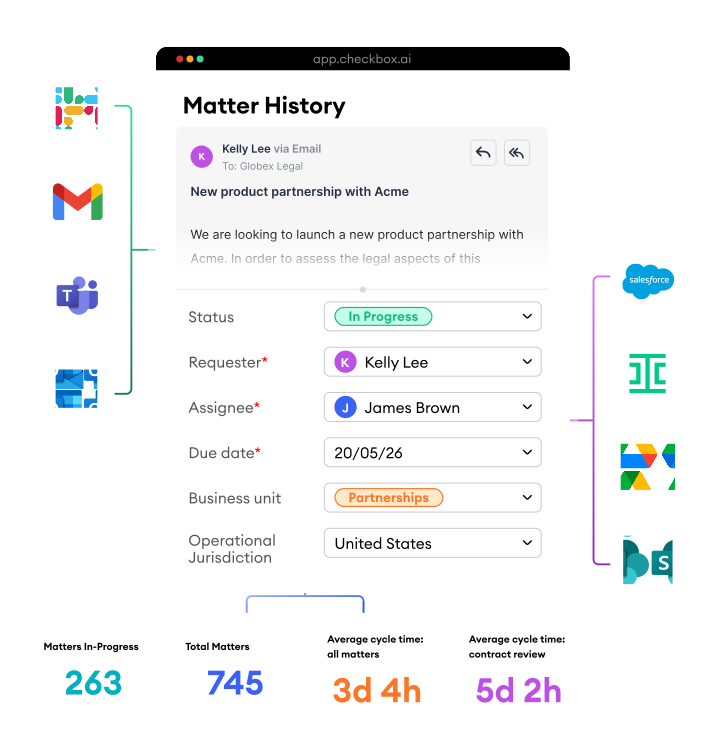
Once you’ve established an internal baseline, the whole benchmarking conversation changes. Instead of saying “our peers spend less than we do,” you can say “our commercial request volume grew 40 percent while our spend grew 10 percent, and here’s exactly where the remaining gap to peers comes from.”
How Should You Present Benchmark Comparisons to Your CFO?
Benchmark conversations in finance can easily fall into anchoring: once a benchmark appears on a slide, it often becomes the target, even when there are caveats. A few habits help keep the comparison useful without letting it take over the meeting.
1. Lead with your own trend line, then place the benchmark beside it as context.
A department whose cost per matter has fallen for four straight quarters can still sit above the peer median and be an obviously well-run function. A legal dashboard that shows your trend alongside the peer figure makes this case in a single visual. But, if you only show the peer gap and ignore that downward trend, the same figure can look like a problem instead of evidence of good management.
2. Explain deviations structurally, in the language of the business.
Saying, “We’re above the staffing median because we closed three acquisitions this year and carry regulatory obligations in two markets our peers don’t operate in,” reframes an unfavorable comparison. It shows you understand why your costs are higher and can clearly explain the specific drivers behind them.
3. Limit the set.
Two or three relevant comparisons are more persuasive than a dozen ratios, because every figure on the slide gives the CFO something concrete to anchor to. In legal operations reporting, the same principle applies: use fewer numbers, and make sure each one supports the decision you want approval for.
Key Takeaways
Legal benchmarks answer the following questions well: what a reasonable spend and staffing range looks like, how work is typically mixed across matter types, and how your cycle times compare to peers. However, they say nothing about your specific demand profile. That gap drives the three classic misuses: using benchmarks to justify headcount without your own demand data, copying another company’s legal tech stack because their numbers look good, and treating the median benchmark as a performance target rather than a reference point.
That’s why an internal baseline comes first. Until you know what comes in, from whom, in what categories, and how long it takes, peer comparisons are trivial. And when the conversation with finance does happen, lead with your own trend, explain deviations structurally, and keep the comparison set small so the median doesn’t become the target by default.
The departments that get the most out of benchmarking are the ones whose own numbers are solid enough to compare. Book a demo today to see how Checkbox captures every legal request at intake, so your baseline data is ready before the next “how do we compare” conversation.